
28 July 2026
Window Frosting vs Blinds for Office Privacy
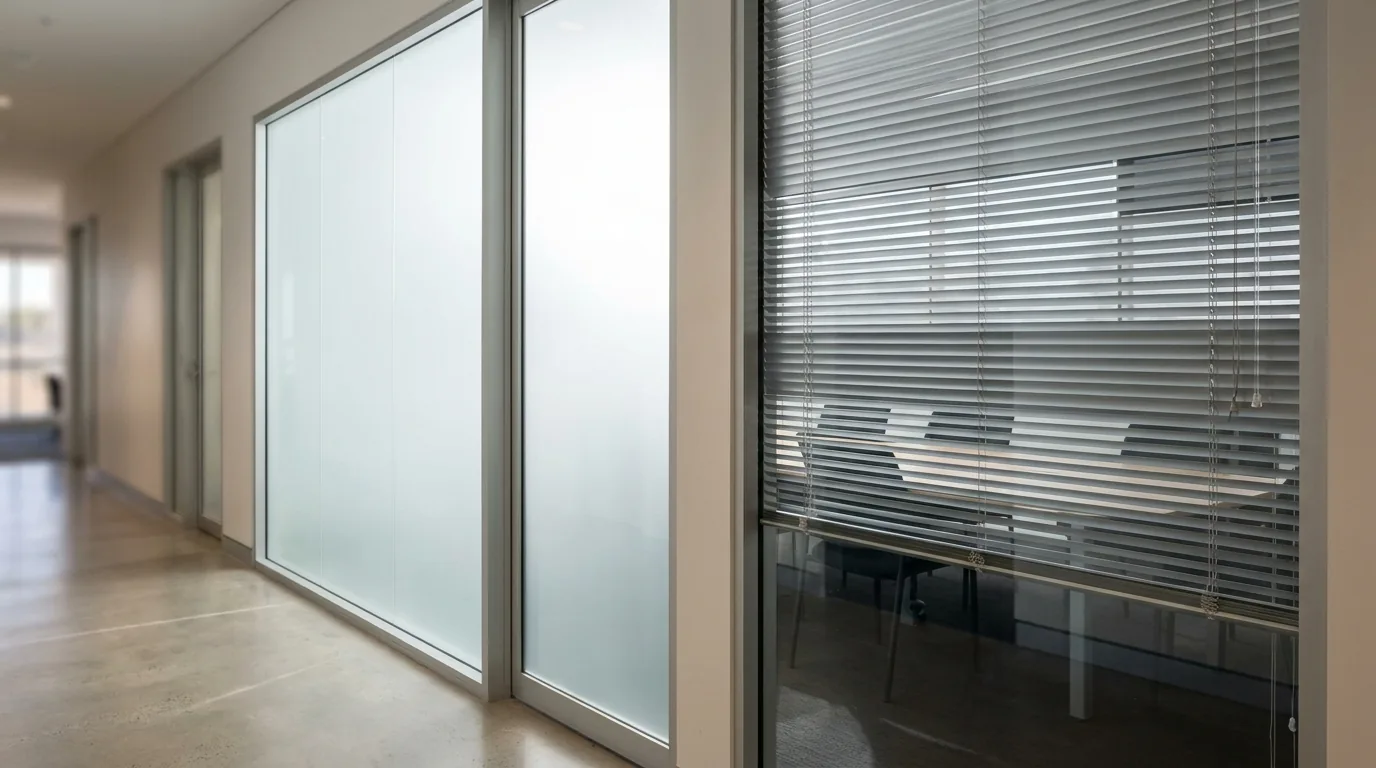
The short answer: for permanent office privacy that still lets daylight in, choose window frosting -- it blocks sightlines for good, adds no dust, cords or moving parts, and can carry your logo. Choose blinds when you genuinely need to adjust light and view through the day. At Gigantic Signs we cut and fit frosting film in-house here in Adelaide.
We've been fitting out Adelaide offices with window frosting for over 30 years from our Kent Town workshop, so facilities managers ask us this constantly when weighing a meeting-room glass wall against a set of blinds. Both do the privacy job -- they just do it very differently. To see the film itself, our window frosting and tint films page shows the finishes, then come back and we'll compare the two properly.
Privacy: which actually blocks sightlines?
Both block the view, but frosting blocks it permanently across the whole pane, while blinds only block it when someone remembers to close them.
- Frosting is always on -- it obscures sightlines 24/7 the moment it's applied, so a glass meeting room or street-facing office stays private even after the last person has left.
- Blinds rely on a human -- they only give privacy when pulled down and angled right. Left open, tilted wrong or half-raised, the glass is see-through again.
- Frosting is even and gap-free -- film covers the pane edge to edge, so there are no thin sightline gaps between slats and no light leaks around the sides.
- Choose your privacy zone -- frost a full pane, a banded strip at seated eye level, or a cut-out pattern, blocking the view where it matters and keeping clear glass above and below.
For a fixed partition or a boardroom you always want private, frosting wins: privacy is built into the glass rather than left to whoever walks past the blind cord.
Light: frosting keeps daylight, blinds control it
This is the real dividing line. Frosting is translucent, so it obscures the view while still letting daylight through; blinds trade that daylight for control.
- Frosting = privacy plus daylight -- a frosted meeting room stays bright and open-feeling even with the glass fully obscured, keeping the borrowed light that stops an office feeling like a box.
- Blinds = daylight or privacy, pick one -- closing them for privacy shuts out the daylight and view too. Fine for killing glare on a screen, less good when you just wanted people not to see in.
- Blinds do adjust -- their genuine strength. On a west-facing window copping the afternoon Adelaide sun, tilting slats to cut glare hour by hour is something frosting can't do.
So if the job is standing privacy without going dark, frosting is the clear pick. If it's managing glare through the day, that's blind territory -- and plenty of offices use frosting on internal glass and blinds only on sun-facing external windows.
Maintenance and lifespan
Frosting has no moving parts, so there is far less to go wrong or clean.
- Frosting wipes clean -- a flat film bonded to the glass, it cleans like the glass does. No slats to dust, no fabric to hold allergens, nothing to trap grime.
- Nothing to break -- no cords, chains, wands or mechanisms. Blinds have all of those, and cords fray, mechanisms jam and slats bend or snap in a high-traffic workspace.
- Long, quiet lifespan -- quality architectural frosting film holds up for many years indoors. Blinds are more likely to need a repair or replacement within that window, and no dangling cords means one less office hazard.
For a fit-out you install once and forget, frosting is the low-maintenance option; blinds ask for ongoing attention busy facilities managers would rather skip.
Cost over five years
We won't quote figures here because both depend on your glass sizes, but the shape of the cost is where the two options really split.
- Frosting is a one-off -- you pay once to have the film cut and fitted, and that's essentially it for years, with no recurring spend baked in.
- Blinds can recur -- the up-front price can look similar or lower, but over five years a busy office may repair jammed mechanisms, replace frayed cords or swap out tired slats, and those costs add up quietly.
- Frosting is easy to budget -- one fixed job with nothing to service, so the five-year cost is basically the install and nothing more.
Want the actual number for your space? Price your exact panes on our window graphics calculator, or read the full breakdown in how much does window frosting cost in Adelaide.
Branding: the thing blinds can't do
Here's where frosting stops being just a privacy fix. Because it's a cut film, your logo, wordmark or a pattern can be part of it -- so the same glass that gives you privacy also carries your brand.
- Logo cut into the frost -- a clear logo left within a frosted pane, or frosted branding on clear glass, turns a reception partition into a branded feature the moment visitors walk in.
- Patterns and privacy bands -- geometric patterns, dot gradients or a banded strip at eye level all read as deliberate design, not a cover-up.
- One-way vision option -- for street-facing glass, printed one-way vision graphics run full-colour branding outside while your team still sees out.
- Blinds stay blank -- a blind is a blind. It gives you privacy and nothing for your brand.
If the glass is anywhere clients see it -- reception, a street frontage, a meeting room off the main floor -- frosting earns its place twice over, handling privacy and branding in one hit.
An Adelaide office that went both ways
A professional-services firm fitting out an Adelaide CBD floor came to us torn between frosting and blinds for the whole level. We split it with their facilities manager: frosted film on the internal glass meeting rooms and the reception partition -- with their logo cut into the reception glass -- so those spaces stayed permanently private, bright and branded with nothing to maintain. Blinds went only on the west-facing external windows, where tilting out the afternoon sun genuinely mattered. Two years on, the frosting still does its job untouched and the branded reception glass is the first thing visitors notice. Right tool, right window.
Frequently asked questions
Does window frosting make a room dark?
No. Frosting film is translucent, so it obscures the view while letting natural light through. A fully frosted meeting room stays bright -- that's its main advantage over blinds, which cut the daylight when you close them for privacy.
Can you see through frosted glass at night?
Quality frosting obscures the view day and night. A lit room behind clear glass can show silhouettes after dark, so for street-facing windows we'll recommend a denser film or one-way vision graphics to keep it private around the clock.
Is frosting or blinds better for a glass meeting room?
For a glass meeting room, frosting is usually better: it's always private, keeps the room bright, needs no maintenance and can carry your branding. Blinds only win where you also need to adjust light or fully black out the room for presentations.
Ready to price your office frosting?
If permanent privacy, daylight and branding matter more than adjusting the light, frosting is your answer. Punch in your glass sizes and price window graphics instantly, or for a hand splitting frosting and blinds across a fit-out, get in touch with our Kent Town team. Thirty years of Adelaide offices have taught us how to make your glass look absolutely GIGANTIC.