
22 July 2026
Window Frosting & One-Way Vision Graphics Adelaide
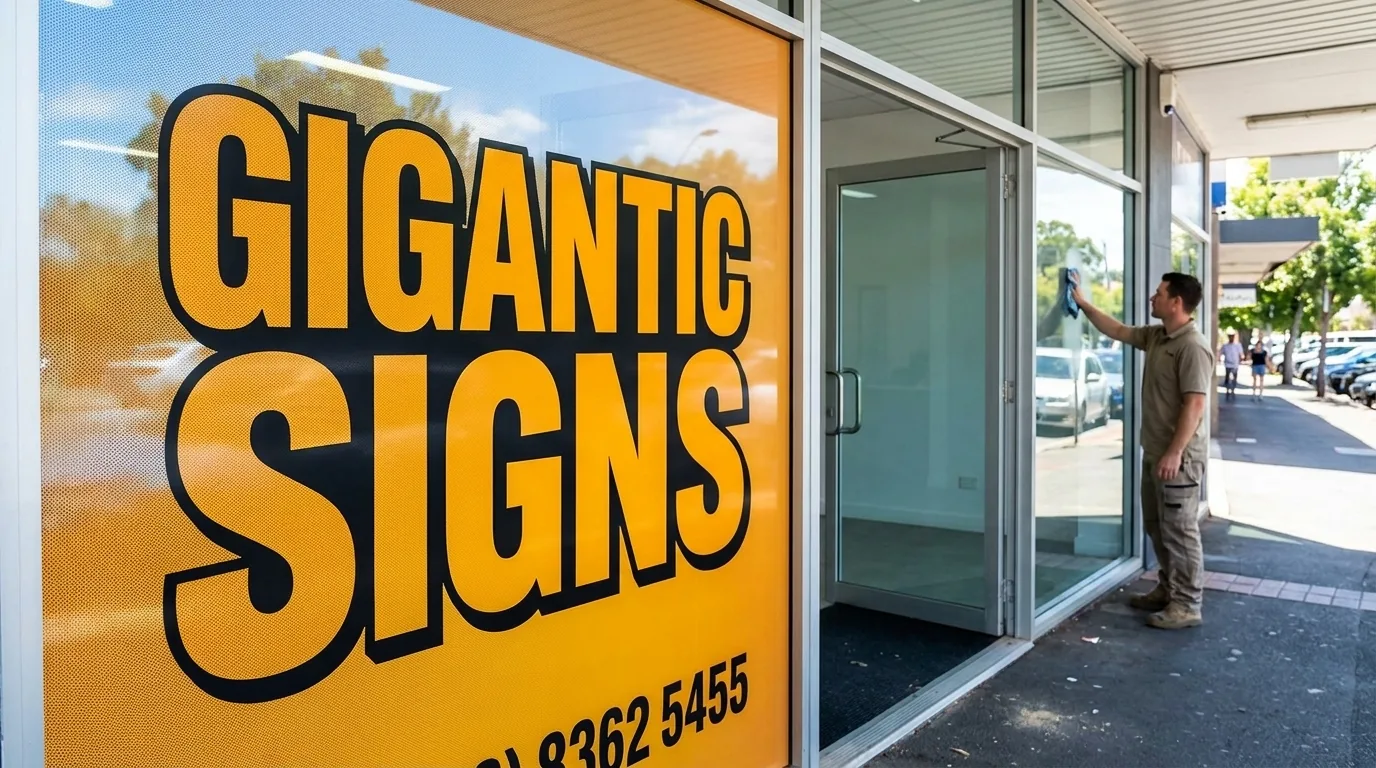
Window frosting and one-way vision graphics are the two films Adelaide businesses use to control what people see through the glass. Frosting is an etched-look film that gives privacy while letting light through; one-way vision is a perforated film that lets you print a full-colour image outside while your team still sees out. Gigantic Signs makes and installs both from our Kent Town workshop.
We've been fitting film to Adelaide shopfronts and offices for over 30 years, and the two films get confused constantly because they both live on glass. They do very different jobs. Frosting is about privacy and a clean, professional finish. One-way vision is about turning your window into a billboard without blacking out the room behind it. Below is how each is made, how they go on, and why the install matters more than most people expect. For the full range see our window frosting and tint films page.
What is window frosting and how is it applied?
Window frosting is a self-adhesive vinyl film with a fine etched or sandblasted appearance. It sticks to the inside face of the glass and diffuses the view through it, so people can see there's light and movement but not detail. It's the go-to for meeting rooms, bathrooms, glass office partitions and any shopfront that wants privacy at eye level without losing daylight.
The film comes in a few forms, and which one you choose changes the look and the price:
- Plain frost -- a solid etched film across the whole pane or a band at eye height. The simplest and cheapest, and the most common in offices.
- Cut-out frost -- your logo, a pattern or clear "windows" cut into the frost so the etched look frames a design. Great for branding a glass entry.
- Printed frost -- colour or a graphic printed onto the frosted film, for when privacy and a full design need to happen on the one pane.
Application is a wet install. We spray the glass and the adhesive side, float the film into position so it can still be slid a few millimetres, square it up, then squeegee the water and air out from the centre. Done properly there are no bubbles, no lifting edges and no trapped dust. It reads like the glass itself was etched at the factory.
How does one-way vision film actually work?
One-way vision is a perforated film, printed with a full-colour image on the outward face and covered with an optically clear laminate so it survives outside and stays sharp. The perforations are thousands of tiny holes across the sheet. From outside, your eye reads the printed image because that's the large coloured surface facing the street. From inside, your eye reads the brighter open scene through the holes, so your team still sees out to the footpath.
That's why one-way vision is the film for a shopfront that wants a big printed graphic without turning the interior into a cave. Retailers use it for full-window campaigns, offices use it for privacy with a branded exterior, and it's a favourite for covering glass that faces a hot street because it cuts glare while it advertises. The trade-off is that the effect depends on light: it works best when it's brighter outside than in, so at night with the interior lit, people outside can see in more than they can by day.
Why does installation quality matter so much?
This is where these two films separate the pros from the weekend job, and one-way vision is the least forgiving film we fit. Because it's perforated, it is unforgiving of dust. Every speck of grime on the glass gets pressed into a hole and shows as a mark you can't squeegee out afterwards. So we detail the glass before a single millimetre of film goes on -- a full professional clean and scrape, not the microfibre wipe a hoarding wall gets. A painted hoarding will hide a bit of dust; perforated film on glass will not, so the prep is the job.
The second thing that separates a good install is how we handle tall glazing. You can't always run one continuous sheet up a high shopfront, and even where you can, film that big can move as it settles. So on tall panes we split the graphic mid-window and lay it in two pieces with a slight overlap. The overlap is deliberate -- it prevents the join opening up if the film shrinks a fraction as it cures, which is what a single hard-butted seam will do over an Adelaide summer. We place that join where it's least noticeable: on a line in the artwork, behind a mullion, or at a height where nobody's eye lands. Get it right and you'd struggle to find the seam even knowing it's there.
None of that shows up in a price alone, which is why two quotes for the "same" window film can be miles apart. The film is a fraction of the story. The detailing, the wet install and the join logic are what you're actually paying a signwriter for. If you're weighing it up on cost, our guide to how much window frosting costs in Adelaide breaks down what drives the number.
Which film suits your shopfront?
The choice comes down to what you're solving for -- privacy, branding, or both:
- You want privacy and light -- frosting. Meeting rooms, bathrooms, office partitions and lower shopfront glass. It's the quiet, professional option and the one people compare against blinds. If that's your call, see frosting versus blinds for office privacy.
- You want a printed graphic but still need to see out -- one-way vision. Full-window retail campaigns, branded exteriors and glass on a busy or sun-hit street.
- You want branding with no need to see through -- printed or cut-out frost, or a solid printed graphic. When the view out doesn't matter, you have more options and often a lower cost.
A retailer on one of Adelaide's busy main-road strips came to us wanting a full-window promotion but was worried the shop would go dark inside. We fitted one-way vision across the frontage: a bright printed campaign facing the street, and staff who could still watch the footpath and keep an eye on passers-by. The glass was tall, so we split the graphic mid-window and hid the join on a line in the artwork -- you have to be told it's there to spot it. The promotion read like a billboard from across the road, and the room behind it stayed bright.
Frequently asked questions
Can you see through one-way vision film at night?
The effect depends on light. By day, with it brighter outside than in, people outside see the printed image and you see out. At night, with the interior lit and the street dark, that reverses and people outside can see in more. If night privacy matters, pair it with lighting choices or ask us about the right film for the room.
Does window film damage the glass or come off cleanly?
Quality film removes cleanly when the time comes, leaving the glass as it was. It's applied to the surface with adhesive, not bonded permanently. Poor removal is usually cheap film or a rushed job -- another reason the install matters.
Can you match our existing frosted or printed film?
Often, but it depends on having the original artwork and film spec. Frost styles and print colours vary between suppliers, so matching by eye alone is hard. We cover what's possible in can you match existing frosted window film.
Ready to price your window graphics?
Whether it's privacy frost or a full one-way vision campaign, you can price it instantly online. Jump on the one-way window sticker calculator for perforated vision film, use the window graphics calculator for printed and frosted work, or browse the full range in the Gigantic Signs Online Store. Thirty years detailing Adelaide glass, and every job we fit goes on GIGANTIC.