
6 August 2026
Why Is My Illuminated Sign Dim, Patchy or Unevenly Lit?
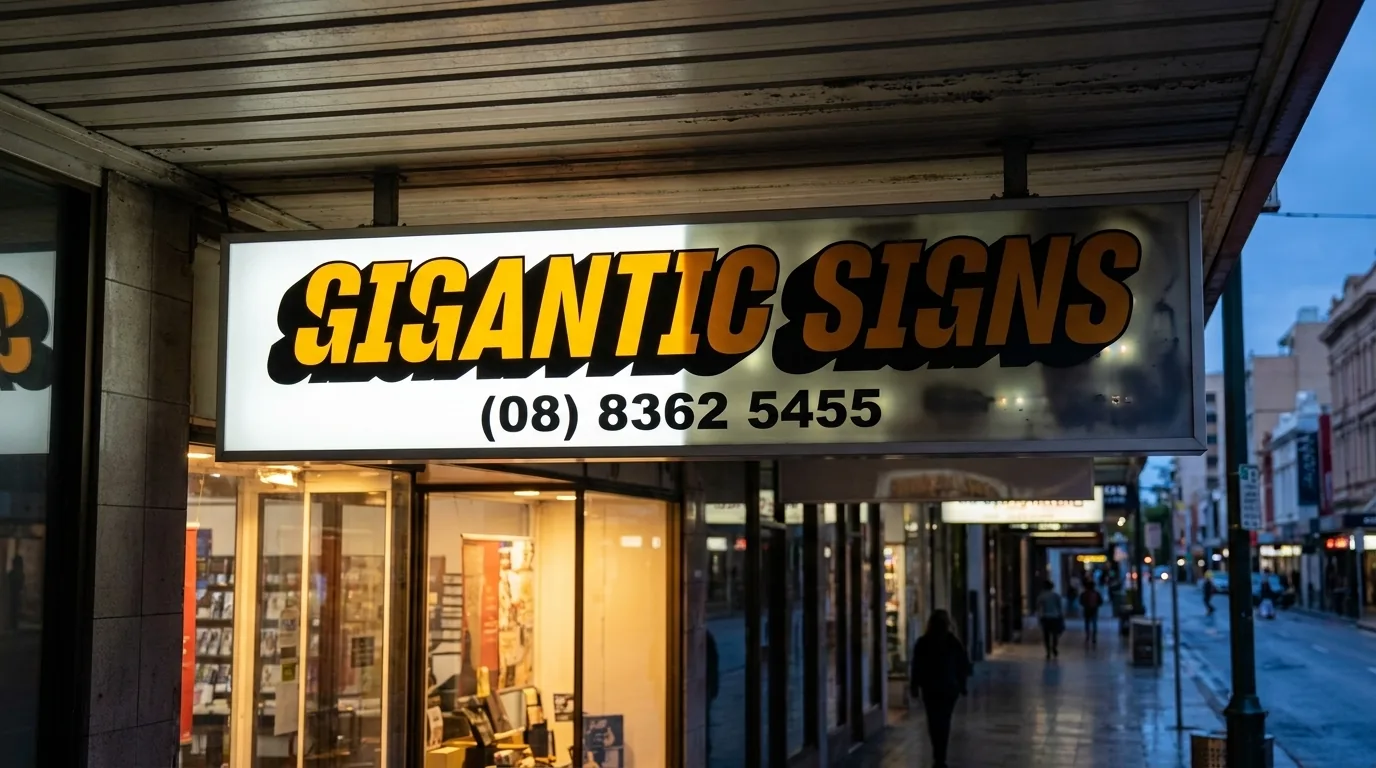
Why is my illuminated sign dim or unevenly lit? The short answer from Gigantic Signs in Adelaide: it is almost always the wrong build, not a dying bulb. Edge-lit letters, opaque white acrylic where opal should be, or a failed driver leave a sign patchy and weak. Most are fixable. Our Kent Town team diagnoses these every week.
We have been building and repairing illuminated signs for Adelaide businesses for over 30 years, and dim or blotchy lighting is one of the most common problems people bring to us. It usually is not that the sign is old or the LEDs are worn out. More often the sign was built the wrong way from the start, or a single component has quietly failed. Everything we service is worked on at our Kent Town facility, so we can open a light box up and tell you plainly. If you want the range we build, see our illuminated signs page -- but first, here is what causes a weak or patchy glow.
Why is only part of my sign lighting up?
When a sign is bright in some spots and dark in others, it is rarely a mystery. The most common causes we find when we open the box are:
- A failed LED module or run -- illuminated signs are lit by strings of LED modules, not one big lamp. If one string dies, that section goes dark while the rest keeps glowing. That is why half a sign can drop out overnight.
- A dead or failing driver -- the driver is the power supply that feeds the LEDs. Many signs run more than one, each powering a zone. Lose a driver and its whole zone goes dark, even though every LED on it still works.
- Edge-lighting instead of back-lighting -- if the light was only ever fed in from the sides, the middle of a large face was never going to glow evenly. The centre reads dull and the edges look hot.
- Water or corrosion -- a light box that has let moisture in can short a run of modules or corrode a connection, killing a section.
The good news is that most of these are repairs, not replacements. A failed module string or a dead driver can be swapped out, provided the sign was built so the internals can actually be reached. That last part matters more than people expect, and it is worth its own read: where the old installer hid the driver decides how cheap or painful the fix is.
Edge-lit vs back-lit: what is the difference?
This is the single biggest reason a sign looks dim even when nothing has failed. The two ways to light a sign face are not equal:
- Back-lit -- the LEDs sit behind the face and push light straight out through it towards the viewer. Done right, the whole face glows evenly and reads brightly from across the road. This is what most people picture when they think of an illuminated sign.
- Edge-lit -- the LEDs sit around the perimeter and light is meant to travel across the panel from the sides. It works for thin, small pieces, but on a larger face the light falls away before it reaches the middle. You end up with bright edges and a dull centre.
If your sign is bright around the border and washed out in the middle, edge-lighting is the likely culprit. On a shopfront light box you almost always want it back-lit, so the light comes at you rather than skimming across the face. Swapping an edge-lit build for a proper back-lit panel is one of the most reliable ways to turn a tired, dim sign into one that carries at night.
Did my sign maker use the wrong acrylic?
Often, yes -- and it is one of the most common mistakes we see. The acrylic the light passes through decides how the sign looks lit up, and there is a real difference between the grades:
- Opal (diffused) acrylic -- this is the correct choice for a lit face. It lets light through and spreads it so the surface glows evenly, with no bright spots or hot lines where individual LEDs sit behind it.
- White (opaque) acrylic -- this looks similar in daylight but it does not let light through and it does not diffuse. Put it over LEDs and light only escapes at the cut edges of the letters or panel. The face itself stays dull.
- Push-through letters -- letters cut from acrylic and pushed through the sign face. When they are made from opal and back-lit they glow beautifully. When they are made from opaque white, only the edges catch the light and the rest of the letter reads flat.
White acrylic does not let light through, and it does not diffuse. If a previous contractor reached for standard white sheet instead of opal, the sign was never going to be bright, no matter how many LEDs are behind it. It is the wrong material for the job, and it is a big reason a supposedly new sign can look dim from day one.
Is it worth repairing, or should I replace the whole sign?
It depends on which of the problems above you have. As a rough guide:
- Failed LEDs or a dead driver -- usually a repair. If the box can be opened and the internals reached, we replace the failed parts and the sign is bright again. The sign body itself is generally the longest-lived component.
- Wrong acrylic or edge-lighting -- this is a build fault, not a worn part, so it needs the affected panel or face re-made the right way. Often that is dropping a proper back-lit opal panel into the existing box rather than starting over.
- Water damage or a box that cannot be serviced -- this is where replacement can win, especially if the original was sealed shut and the internals were never meant to be reached.
A dim sign is not automatically a write-off. In a lot of cases we keep the structure you already paid for and fix the part that was done wrong. If you are weighing this up, our guide on how long illuminated signs last breaks down which components fail first and what a fair lifespan looks like.
An Adelaide example: a dim under-awning light box
A Rundle Mall jeweller came to Gigantic Signs frustrated that their under-awning light box looked dim and half burnt-out. When we looked, the cause was clear: the previous contractor had edge-lit the push-through letters instead of back-lighting them, and had used opaque white acrylic where it should have been opal. Light was only escaping at the cut edges of the letters, so the sign read weak no matter what. We built and dropped in a full back-lit panel with the correct diffused acrylic, and had it glowing evenly within a week. Same box, right materials, completely different sign.
Frequently asked questions
Why is my illuminated sign not bright enough?
Usually because it was edge-lit rather than back-lit, or built with opaque white acrylic instead of opal. Both stop the face glowing evenly. It is a build fault, not the LEDs being too weak, and it can be corrected.
Why did half my sign suddenly go dark?
A sudden loss of one section is typically a failed LED run or a dead driver powering that zone. The rest of the sign keeps working because it is on a separate string. Both are repairs if the box can be opened.
Can a dim sign be fixed without replacing it?
Very often, yes. Failed LEDs and drivers are swapped out, and a wrong-acrylic or edge-lit face can be re-made as a back-lit opal panel inside the existing box. Full replacement is usually only needed when a box is water-damaged or sealed shut.
Get your sign looking bright again
If your illuminated sign is dim, patchy or half dark, do not assume it is finished. It is usually a fixable build fault or a failed part. Call our Kent Town team on (08) 8362 5455 or get in touch and we will tell you plainly whether it is a repair or a rebuild. You can also price a new illuminated sign instantly with our quote tool. Thirty years on, we still reckon a sign should glow properly the first time -- and ours are built GIGANTIC.