
21 August 2026
Who Signs Off Your Signage: Builder, Architect or You?
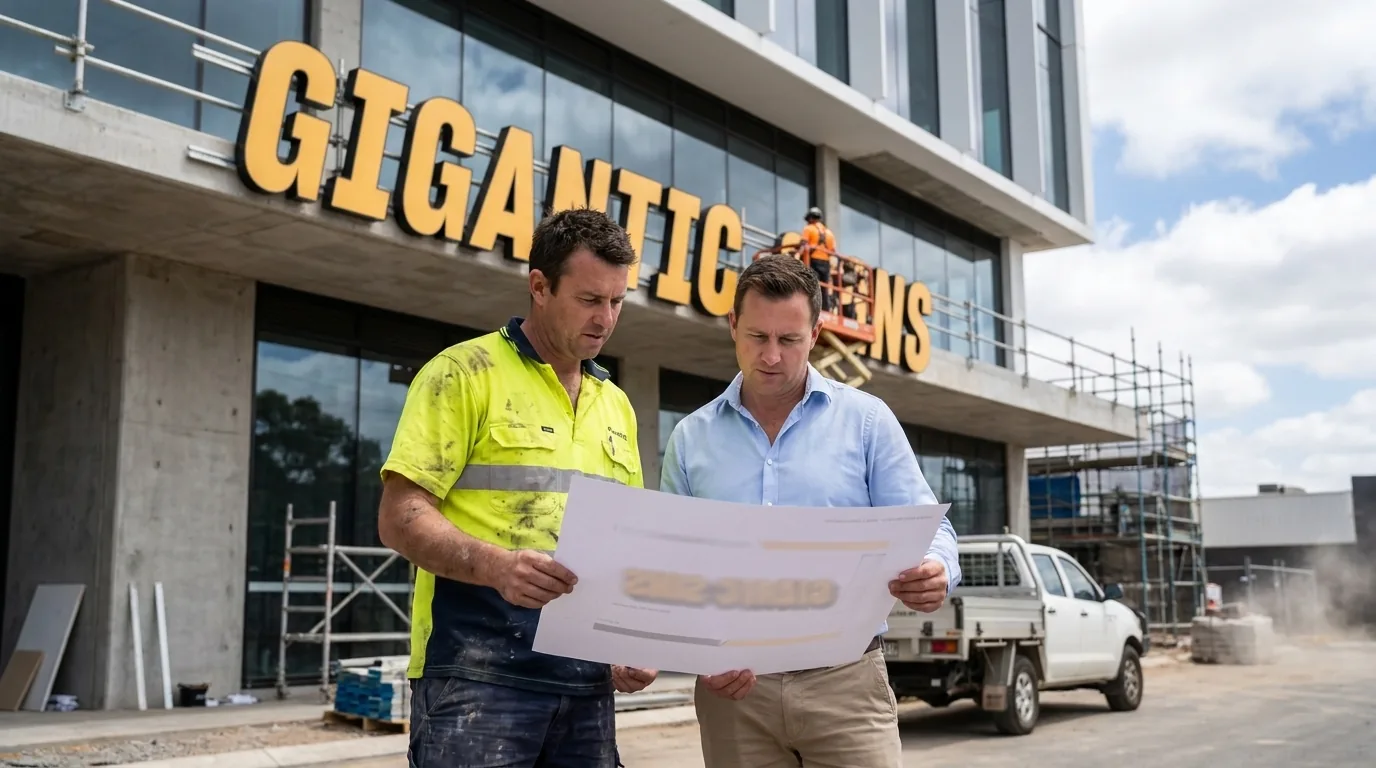
Who should sign off the signage on a new building? The short answer: the business whose brand it is -- not just the builder or the architect. At Gigantic Signs in Kent Town, Adelaide, we always ask to speak to the end customer before a logo goes into production, because a sign approved on a drawing can still be wrong on the wall.
We have been fabricating and installing building signage for Adelaide projects for over 30 years, all out of our Kent Town facility. In that time we have learned that the costliest signage mistakes are almost never technical -- they are approval mistakes. The wrong person says yes, or the right person never gets to look, and a sign that was signed off on paper turns out to be the wrong logo, the wrong size, or in the wrong spot once it is up. This is a coordination problem, and it is worth understanding before your project reaches the fit-out stage. If you want the fabrication detail behind these jobs, see our building signage page.
Who normally approves signage on a build?
On a typical commercial build, signage passes through several sets of hands before anyone makes it. The approval chain usually runs like this:
- The architect or designer -- puts signage on the drawings as a placement, showing roughly where the name sits and how big it reads. This is a design intent, not final artwork.
- The builder or project manager -- coordinates the trades and signs off against the drawings. They are checking that the sign matches the plan, not that the logo matches the brand.
- The sign maker -- fabricates from whatever artwork and dimensions come through. A good one will question anything that looks off before cutting material.
- The business owner or tenant -- the one person who actually knows what the brand is meant to look like, and the one most often left out of the sign-off loop.
The gap is obvious once you name it. The people signing off the artwork are checking it against a drawing, and the person who could check it against the real brand is not in the room. That is where things go wrong.
What goes wrong when the owner never sees the artwork?
Here is a real one. On a national logistics operator's new build, the architect had put the company name onto the drawings as a placement example -- they had simply typed out the letters in the right font to show where the sign would sit. It was never meant to be the final logo. But the drawing went round, the builder and the architect both signed it off, and it landed with us looking like approved artwork.
The owner flew in as the sign was going up and asked, straight away, why the logo looked wrong. It was not their logo at all -- it was placeholder text in the right typeface. We compressed and adapted the real logo on site to make it fit and read correctly, and got it approved by the person who actually owned the brand. Everyone had done their job against the drawing. The drawing was just never the brand.
This is exactly why our first question to a builder is usually, "can we speak to the customer?" It is not us going around anyone. It is the one check that catches a placeholder before it becomes a fabricated, installed, signed-off mistake that someone has to pay to redo.
What if the sign doesn't fit the as-built structure?
The other approval trap is dimensional. Buildings are rarely built to the millimetre the drawings promised, and large signage is unforgiving about it. On one project the architect's drawings called for letters to sit inside a picture-frame gap that was meant to be 10m wide. As built, the gap came out at 10.5m. That half a metre meant the pre-made mounting rails we had prepared to the drawing no longer fitted the opening.
Rather than force it, we re-centred the letters to the real opening on site and had the new layout re-approved before fixing anything permanently. The lettering looked balanced in the actual gap, not the drawn one. A sign maker who just installs to the drawing would have left you with letters bunched to one side of a wider frame, technically correct and visibly wrong.
The lesson is the same in both stories: the drawing is a starting point, and final sign-off has to happen against the real building and the real brand. That means a measure-up on the as-built structure, and a look from the business owner, before anything is locked in.
How to get signage sign-off right
You do not need a complicated process. A few habits catch almost every signage approval problem before it costs anyone money:
- Get the owner or tenant to approve the actual logo -- not the placement on the architect's drawing. Confirm it is the real, current brand artwork.
- Let the sign maker talk to the end customer -- one short conversation replaces a chain of assumptions passed down through the drawings.
- Measure the as-built structure before fabrication -- confirm the real opening, not the drawn one, so rails and letters are made to fit.
- Re-approve any on-site changes -- if a sign is re-centred or adapted to suit the building, get a fresh yes before it is fixed permanently.
Getting the timing right matters too. Signage is one of the last trades on site, but the artwork and approvals need sorting well before that. See how far ahead you should order signage for a new building for the sequencing, and what large-scale building signage costs on a construction project for the budget side. The range of what can go on a building is covered in our guide to outdoor building sign types.
Frequently asked questions
Who has final sign-off on signage for a new building?
The business whose brand appears on the sign should give final sign-off on the artwork. The builder and architect approve placement and size against the drawings, but only the owner or tenant can confirm the logo is correct.
Why does the sign maker want to speak to the end customer?
Because the sign maker only ever sees what is handed down through the drawings, and drawings often carry placeholder artwork. One short conversation with the business owner catches a wrong logo before it is fabricated and installed.
What happens if the building is not built to the signage drawings?
The signage is adapted to the real structure. We measure the as-built opening, adjust the layout so the sign reads correctly in the actual space, and get the change re-approved before fixing anything permanently.
Building signage on a project? Let's get the sign-off right
If you are coordinating signage on an Adelaide build, bring us in early and let us talk to whoever owns the brand -- it is the cheapest insurance on the job. Call our Kent Town team on (08) 8362 5455, or get in touch to walk through your project. When you have the artwork and dimensions sorted, price your building signage with our building signage quote tool. Thirty years on, we still reckon the best sign is the one everyone approved before it was ever made -- and ours are built GIGANTIC.