
14 September 2026
What Is the Australian Standard for Safety Signs? (AS 1319)
Wondering which Australian standard governs workplace safety signs? The short answer: AS 1319-1994, Safety Signs for the Occupational Environment. It sets the colours, shapes, symbols and text rules for every safety sign in an Australian workplace. Gigantic Signs prints compliant safety signage at our Kent Town workshop for businesses right across Adelaide.
We've been making signs for South Australian businesses for over 30 years, and safety signage is one area where getting the details right matters legally. A warning sign in the wrong colour, or a mandatory sign nobody can read from across the floor, can leave a business exposed. Everything we print is made and finished at our Kent Town facility, so we know the standard and build to it.
What is AS 1319?
AS 1319-1994 Safety Signs for the Occupational Environment is the Australian Standard that defines how workplace safety signs look and work. Published by Standards Australia, it standardises the colours, shapes, symbols and text so any worker reads a sign the same way, and it sets a viewing-distance rule so signs are sized to be legible from where people actually need to read them.
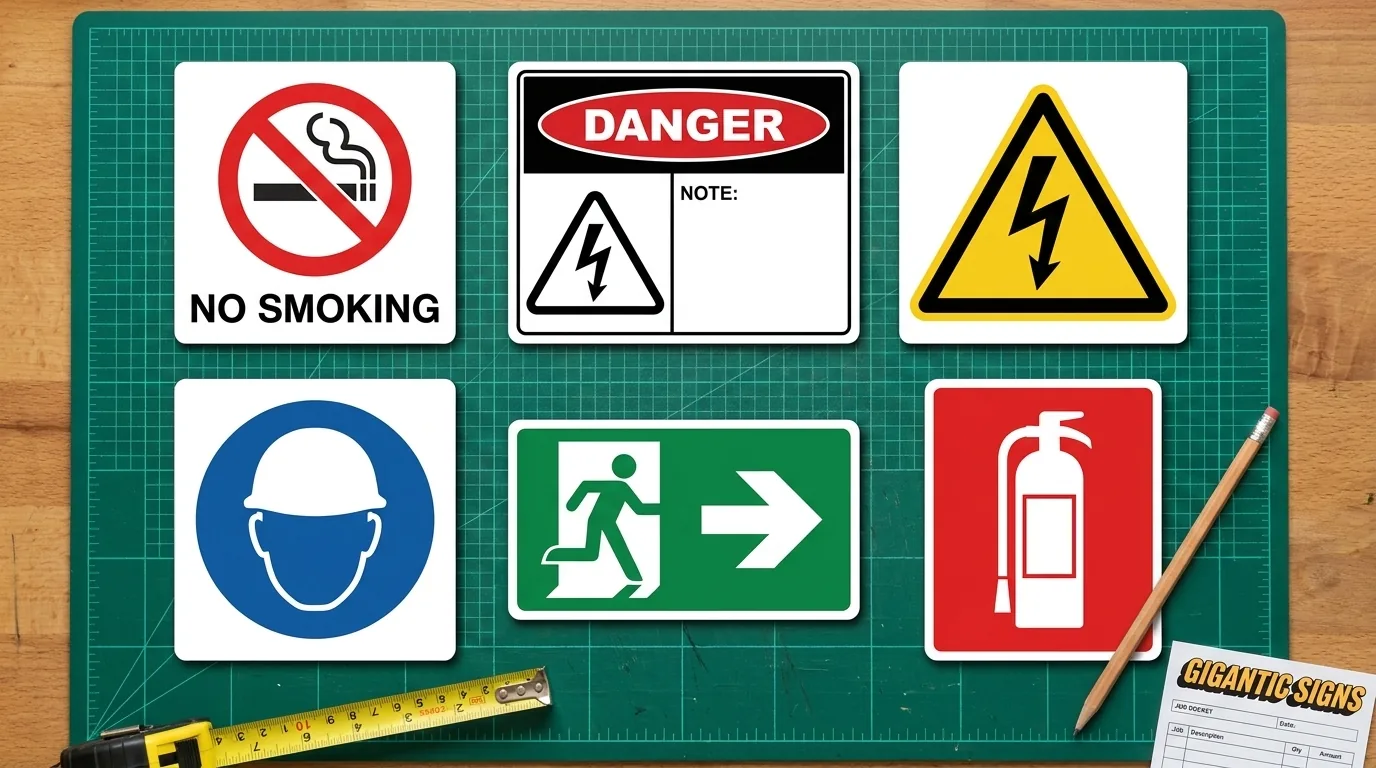
The point of the standard is instant recognition. A red circle with a slash always means "do not", a blue disc always means "you must", a yellow triangle always means "watch out". A worker, visitor or contractor who has never set foot on site still reads the signs at a glance. You can view the current standard on the Standards Australia catalogue page for AS 1319-1994.
Are safety signs mandatory in Australia?
In practice, yes, for the hazards that call for them. Australian work health and safety law does not hand you one master checklist of signs every workplace must own. Instead the Work Health and Safety Act 2011 and its Regulations place a duty of care on every business, a person conducting a business or undertaking, to identify hazards and control the risk. Signage is one of those required controls.
Where the law does spell it out, signs are not optional. You must display signage wherever there are hazardous chemicals, wherever personal protective equipment is mandatory, at emergency exits, and at fire equipment. Safe Work Australia sets this out under its hazardous chemical records and signs for workplaces guidance, and SafeWork SA publishes a plain-English workplace signage resource in its free resources library.
One nuance worth understanding: AS 1319 itself is a voluntary standard, not a law. It becomes legally enforceable when it is "called up", meaning referenced by a regulation or an approved code of practice. So the honest answer is two-part. Displaying safety signs where hazards exist is a legal duty, and following AS 1319 is how you make those signs compliant and recognisable. Treat the standard as your baseline. For an example of how extra rules stack on top of it, see our guide to fire door signage requirements in Australia.
What are the safety sign categories and colours?
AS 1319 groups workplace safety signs into seven types, each with a fixed colour and shape so the meaning is unmistakable. The four families are regulatory signs (prohibition, mandatory and restriction), hazard signs (warning and danger), emergency information signs, and fire signs. Colour does most of the work: red for prohibition, danger and fire, blue for mandatory, yellow for warning, green for emergency information.
- Prohibition -- a red circle with a diagonal slash over a black symbol on white. Tells people what they must not do, such as No Smoking or No Entry.
- Mandatory -- a solid blue disc with a white symbol. Tells people what they must do, most often wear PPE like eye protection, hearing protection or a hard hat.
- Restriction -- a plain red circle without a slash, used for limits such as a site speed limit. The regulatory cousin of the prohibition sign.
- Warning -- a yellow triangle with a black border and symbol. Flags a hazard you need to be careful around, such as a forklift zone or slippery surface.
- Danger -- the word DANGER in white on a red oval inside a black rectangle. Reserved for a hazard that could cause serious injury or death, such as high voltage.
- Emergency information -- a green rectangle with a white symbol. Points to safe conditions and facilities like first aid, emergency exits and assembly points.
- Fire -- red with a white symbol or text, marking the location of fire equipment such as extinguishers, hose reels and hydrants.
If you want the plain-English version of each pictogram and what it means on the floor, we've written a full breakdown in safety signs and their meanings in Australia. Get the colour and shape wrong and the sign fails its one job, so this is the part worth getting a signmaker to build for you rather than printing off a template.
How do you buy compliant safety signs in Adelaide?
Start by working out which hazards your site actually has, then match a sign to each one using the AS 1319 categories above. Buy from a signmaker who prints to the standard on durable materials, not a generic online template, so the colours, symbols and sizing hold up. Gigantic Signs makes compliant safety signage at our Kent Town workshop for businesses across Adelaide.
A quick way to audit your site is to walk it hazard by hazard. Our warehouse safety signs checklist is a good frame even outside a warehouse, because the logic is the same everywhere: entries and exits, PPE zones, chemical stores, fire equipment, plant and machinery. Once you know your list, price a batch instantly with our statutory signs quote tool, or browse ready options in the Gigantic Signs Online Store. Our safety signage in Adelaide page covers materials and durability for SA conditions.
A quick Adelaide example
A distribution warehouse in Adelaide's north came to Gigantic Signs after a WHS review flagged their signage as patchy. Half the mandatory PPE signs had faded to nearly white in the roller-door sunlight, a couple of "warning" signs had been printed on plain paper in the wrong colour, and the fire equipment points weren't marked at all. We worked through their site room by room, mapped each hazard to the right AS 1319 category, and reprinted the lot on UV-stable materials sized to be readable across a full aisle. The facilities manager passed the follow-up review, and now reorders a standard pack whenever the site layout changes.
Frequently asked questions
Is AS 1319 the law?
Not on its own. AS 1319 is a voluntary Australian Standard. It becomes legally enforceable when a regulation or code of practice "calls it up". The legal duty to display safety signs comes from the Work Health and Safety Act 2011 and its Regulations, and AS 1319 is how you make those signs compliant.
What colour is a mandatory safety sign?
Blue. Under AS 1319 a mandatory sign is a solid blue disc with a white symbol, telling people something they must do, most often wearing PPE such as eye or hearing protection. Prohibition signs are red, warnings are yellow, and emergency information is green.
How big does a safety sign need to be?
Big enough to read at the distance workers approach it. AS 1319 uses a viewing-distance rule, so a sign meant to be read across a warehouse aisle is larger than one beside a doorway. When in doubt, size up. We can advise on the right size for each location when you quote.
Get your workplace signage sorted
Work out your hazards, match each to the right AS 1319 category, and get them printed properly. Price a batch instantly with our statutory signs quote tool, browse the range in the Gigantic Signs Online Store, or get in touch and our Kent Town team will help you build a compliant set for your site. Thirty years on, we still make sure every Adelaide safety sign we print is built to the standard, and built GIGANTIC.