
16 September 2026
Warehouse Safety Signs Checklist (Adelaide)
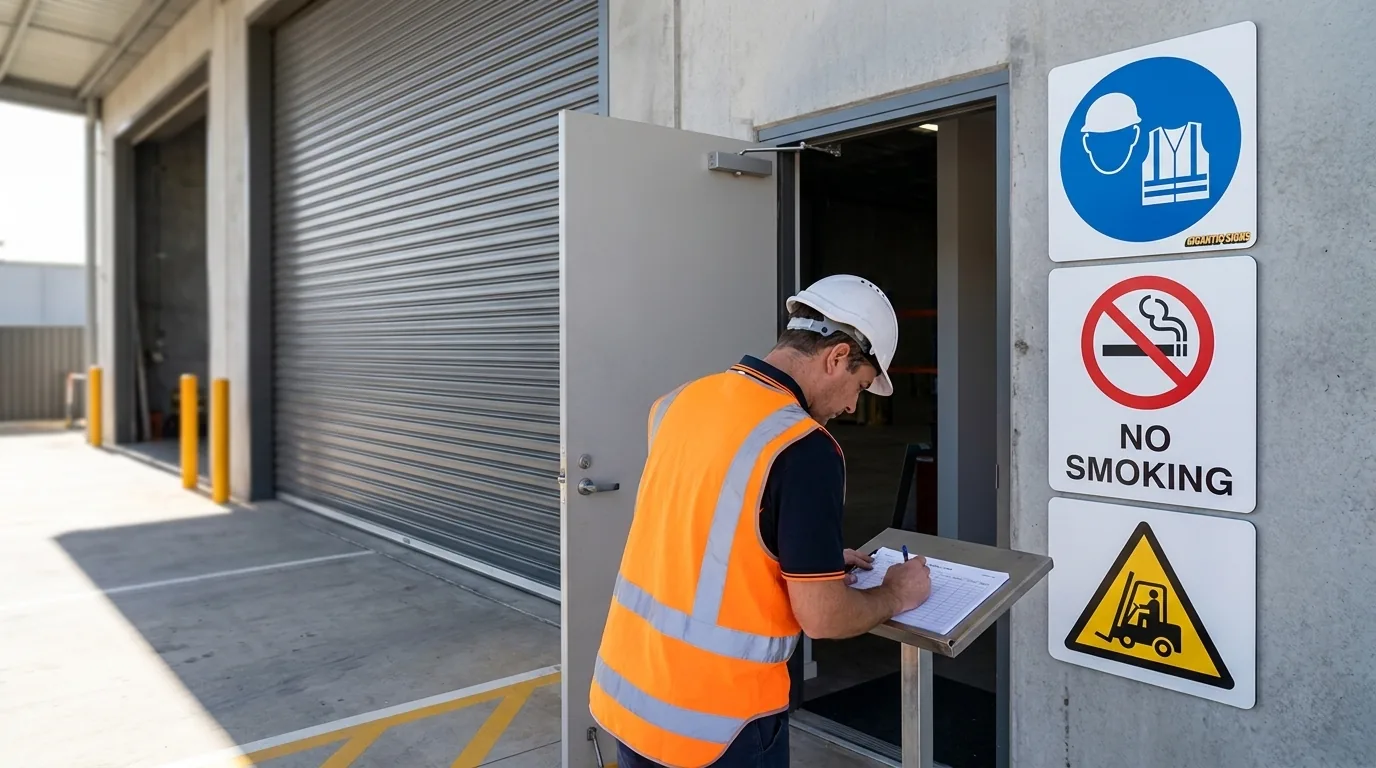
Fitting out a new warehouse in Adelaide and not sure which safety signs you actually need? The short answer: most sites need a core set of prohibition, mandatory, warning, emergency and fire signs, plus traffic and entry signage matched to your real hazards. Gigantic Signs builds them all at our Kent Town workshop.
We've been making signs for Adelaide businesses for over 30 years, and warehouse fit-outs are one of the jobs we get asked about most, usually when a site is about to open and someone realises the safety signage was left to the last week. Everything is designed, printed and finished at our Kent Town facility, so we can turn a full site-safety set around quickly and match it to your floor plan. For the wider picture, see our safety signage in Adelaide overview. This checklist covers what most warehouses commonly need and what a safety consultant will look for when they walk your site.
One thing to hold onto before you order anything: signs are an administrative control. Per SafeWork SA guidance on managing risk, a sign warns people of a hazard and helps minimise exposure, but it does not remove the hazard. Sort out the physical controls first, then sign what remains.
What safety signs does every warehouse need?
Australian safety signs follow a colour-and-shape system set out in AS 1319-1994, Safety Signs for the Occupational Environment. That standard defines what each sign should look like so anyone on site reads it the same way. Most warehouses need at least one of each category below. This is the base set to walk through room by room:
- Prohibition signs (red circle with a slash) -- what must not happen. No smoking and no e-cigarettes, no unauthorised entry, no pedestrians in forklift lanes. These sit at entries and near any restricted zone.
- Mandatory signs (blue circle) -- what people must do. High-vis required, safety footwear, hearing or eye protection in specific areas. Place them right where the rule starts to apply.
- Warning signs (yellow triangle) -- a hazard that needs care. Forklift traffic, uneven surfaces, overhead loads, racking above head height.
- Danger signs (red oval on white) -- where contact or a wrong action could cause serious injury. Switchboards, high voltage, moving machinery, battery-charging bays.
- Emergency and safe-condition signs (green square) -- where to go and what to reach when something goes wrong. Exits, first aid, emergency stops, assembly point, eyewash or safety shower.
- Fire signs (red square) -- fire equipment and its location. Extinguisher and hose reel markers, fire indicator panel, hydrant.
If you store dangerous goods or hazardous chemicals, that carries its own placarding rules on top of the general set. Check the Safe Work Australia guidance on hazardous chemical signs and placards and treat those as a separate line item.
What's specific to loading docks and traffic?
The biggest warehouse hazard is usually vehicles and people sharing the same floor. Loading docks, forklift lanes and truck approaches need signage that separates the two and slows traffic where they cross. This is the part a safety consultant tends to focus on hardest:
- Forklift and pedestrian separation -- warning signs for forklift traffic, plus mandatory signs marking designated walkways and crossing points.
- Speed and give-way signs -- internal speed limits for forklifts and vehicles, give-way at blind corners and dock aprons.
- Loading-dock edge and reversing signs -- fall-from-height warnings at open dock edges, and reversing or spotter signs where trucks back in.
- Driver safety zone signage -- a clear sign telling arriving drivers where to stand, wait and report while their truck is loaded or unloaded. This is often a custom sign matched to your yard layout, not an off-the-shelf item.
- Height and clearance signs -- overhead door heights, low-clearance beams, and any racking or mezzanine load limits.
Entry, exit and visitor signage
A warehouse should be easy to enter the right way and impossible to enter the wrong way. Get the perimeter and the doors right and you head off a lot of incidents before anyone is inside:
- Single controlled entry point -- direct all visitors and drivers to one entry with clear "entry" and "no entry" signage, so people don't wander in through a dock or side door.
- Site induction and PPE-on-entry signs -- report to the office, sign in, and put on the required PPE before going past the line.
- Fire-door signage -- fire and exit doors must be clearly identified and kept clear. See our guide to fire door signage requirements in Australia for the detail.
- Emergency exit and assembly signs -- lit or reflective exit markers along the egress path, and a clearly signed assembly point outside.
- Visitor and contractor rules -- a plain-language board at reception covering sign-in, escorts and site rules.
How do you know your signs are compliant?
Compliance is less about ticking a fixed list and more about matching signs to your real hazards, then getting the design right. Walk the site and identify hazards room by room, choose the sign category that fits each one, use the AS 1319 colours, shapes and wording so it reads correctly, and place each sign where people see it before they reach the hazard. The one thing worth paying for is a safety consultant or your WHS adviser to walk the site with you, because they see risks a floor plan hides. For the meaning behind each symbol, our post on safety signs and their meanings in Australia is a handy reference, and the official SafeWork SA Safety signs in the workplace resource is worth keeping on hand.
Once you know your list, price a full statutory-sign set for your warehouse in minutes with the calculator below.
A recent Adelaide warehouse fit-out
A new logistics site in Adelaide came to Gigantic Signs needing a full site-safety set before opening day. Rather than guess, they walked the site with a safety consultant and we built to that brief: a single controlled entry with "entry" and "no entry" signage so drivers and visitors could only come in one way, no-smoking and no-e-cigarette prohibition signs across the yard and dock, clear fire-door signage on every fire and exit door, and a custom driver safety zone sign telling arriving drivers exactly where to stand and wait while their truck was handled. One coordinated set, matched to their layout, finished at Kent Town and ready before the first pallet moved. For the specifics on that last one, we've written up driver safety zone signage requirements in SA.
Frequently asked questions
Are warehouse safety signs a legal requirement?
Safety signage is part of managing risk under the Work Health and Safety framework, and where a hazard remains after other controls, a sign is often how you warn people. The categories and design come from AS 1319-1994. For your specific duties, check current SafeWork SA guidance or your WHS adviser.
Can you make custom warehouse signs, not just standard ones?
Yes. Standard prohibition, mandatory and warning signs are quick to produce, and we also make custom signs like driver safety zone boards, site rules and yard-specific traffic signs matched to your layout, all at our Kent Town workshop.
How long does a full warehouse sign set take?
It depends on the size of the set and whether any signs are custom, but because we design and print in-house at Kent Town we can usually turn a coordinated set around quickly. Get your list to us early and we'll work to your opening date.
Ready to sign your warehouse?
Work through the checklist, mark what your site needs, and you're most of the way there. Price your set instantly with our statutory signs quote tool, browse the full range in the Gigantic Signs Online Store, or get in touch and our Kent Town team will help you build the right set. Thirty years on, we still make Adelaide's safety signage properly, and GIGANTIC.