
21 July 2026
Shopfront Signage Adelaide
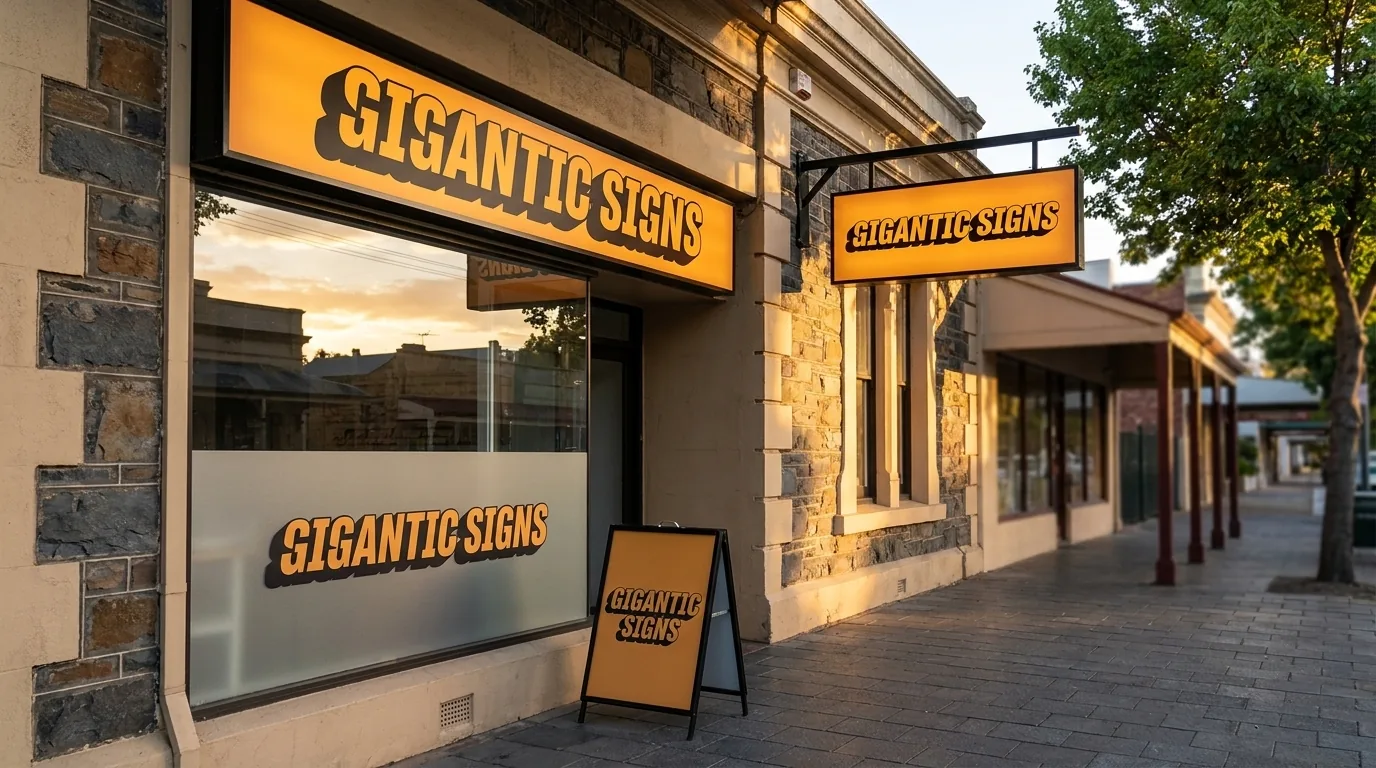
Setting up or refreshing a shopfront in Adelaide? The short answer: a good shopfront needs a layered kit, not one sign -- a fascia sign to name the business, window graphics for privacy and offers, illumination so it reads after dark, and a footpath sign to pull passing trade. Gigantic Signs designs, builds and installs the lot from our Kent Town workshop.
We've been making shopfront signage for Adelaide businesses for over 30 years, so we know what actually earns its keep on a busy street and what warps in the first hot northerly. This page walks through the pieces of a shopfront sign system, how each one works, and how to price the whole job. Browse finished products any time in the Gigantic Signs Online Store, or price a standard sign instantly with our online quote tool.
What makes a shopfront sign work?
A shopfront sign has one job: turn people walking or driving past into people walking in. The shopfronts that do this well almost never rely on a single sign. They layer a few elements that each catch a different viewer at a different distance, and they read clearly by day and after dark. The four building blocks are:
- The fascia or building sign -- your name above the door, the anchor of the whole shopfront and the thing seen from furthest away.
- Window graphics -- the glass you already have, working as advertising space, privacy screening, or both.
- Illumination -- so the sign still sells at dusk, in winter, and after close.
- A footpath sign -- the last nudge that catches someone right at your door.
You don't need all four on day one. But knowing the full kit helps you spend in the right order. The sections below cover each piece, and if you want the numbers up front, jump straight to how much shopfront signage costs in Adelaide.
Fascia and building signs
The fascia sign is the workhorse of any shopfront -- the panel or lettering across the top of your building that carries your name. Most Adelaide fascias are printed aluminium composite (ACM) panels, which are light, weatherproof and cost-effective, or fabricated 3D lettering for a premium look. The right choice depends on your building, your budget and how much reach you need down the street.
- Printed ACM panels -- the everyday shopfront sign. Full-colour, flat-mounted to the fascia, and good for years of Adelaide sun when printed with UV-rated inks.
- 3D fabricated lettering -- individual raised letters that throw a shadow and read as a serious, established business. Can be flat, lit, or halo-lit.
- Under-awning and projecting signs -- smaller signs hung at right angles to the wall so people walking along the footpath see you before they're standing in front of you.
See the full range and how each type suits different buildings on our building and shopfront signage page.
Window graphics and frosting
Your windows are advertising space you're already paying rent on. Vinyl graphics, frosting and one-way vision film turn plain glass into part of the sign system -- and they're one of the most cost-effective moves a shopfront can make, because there's no structure to build.
- Cut vinyl and printed graphics -- opening hours, phone number, offers and logos applied straight to the glass.
- Frosting -- an etched-glass look for privacy on a consult room, bathroom or office without blocking light.
- One-way vision film -- perforated film that carries a full printed image on the outside while you still see out from inside.
One-way vision is a craft job, not a stick-on. The perforated film is laminated with an optically clear laminate so it stays sharp, and because it's unforgiving of dust the glass has to be professionally detailed first -- unlike a hoarding wall that just gets a wipe. On tall glazing we split the film mid-window with a slight overlap to stop shrinkage and hide the join where it's least noticeable. For the full method, read how window frosting and one-way vision graphics are made and installed.
Illuminated shopfront signs
An illuminated sign keeps working after the sun goes down -- through an Adelaide winter that's most of your trading afternoon. Lightbox signs and halo-lit lettering both add real impact, but illumination is also where cheap jobs go wrong, because getting light to spread evenly across a face is harder than it looks.
A Rundle Mall jeweller came to us with an under-awning light box that looked dead -- dim, and only glowing at the edges of the letters. The previous contractor had edge-lit it instead of back-lighting it, and used white acrylic where the letters should have been opal. White acrylic is opaque and doesn't let light through or diffuse it, so the light only escaped at the cut edges. We dropped in a full back-lit panel with the right diffusing face and had it reading bright and even within a week. That single difference -- back-lit versus edge-lit, opal versus white acrylic -- is what decides whether an illuminated shopfront reads or dies. We break it down in why illuminated signs go dim or unevenly lit.
Footpath signs
The fascia catches people down the street; the footpath sign catches them at the door. An A-frame on the kerb is one of the cheapest, hardest-working signs a shopfront can own -- you buy the frame once and swap the printed insert as often as you like, so today's coffee deal costs a fraction of the first message. Metal frames built for daily outdoor use stand up to wind and sun far better than the light snap-frames, and a base weight keeps them planted in an exposed spot. See the options in our guide to A-frame and free-standing signs in Adelaide.
How to price your shopfront
Two shopfronts of the same width can differ in price by a factor of ten, so a single number is meaningless until you know what's driving it. The things that move the price are:
- Materials -- printed ACM panels are the value option; acrylic, fabricated metal and 3D lettering step the price up.
- Illumination -- non-lit is cheapest; lightboxes and halo-lit lettering add both impact and cost.
- Size and coverage -- one fascia panel is one thing; wrapping a full facade with matching window graphics is another.
- Installation access -- ground-level fitting is straightforward; boom lifts, traffic management or after-hours work add labour.
The smart play is usually to layer cost-effective elements rather than buy one oversized premium sign -- a printed fascia plus window graphics gives big visual coverage without big fabrication cost. For the full breakdown of ranges and drivers, read how much shopfront signage costs in Adelaide, and price a standard panel sign instantly with our online quote tool.
Frequently asked questions
What signage does a new shopfront need?
At minimum, a fascia sign with your name and some window graphics for hours and contact details. Most shopfronts then add illumination so they read after dark and a footpath sign to catch passing trade. Fit-outs like cafes, clinics and studios usually also need interior signage such as menu boards, a wall logo or a reception sign.
Do I need council approval for a shopfront sign in Adelaide?
Sometimes. Small signs within certain size limits are often exempt, but illuminated, projecting or large signs frequently need development approval from your local council. We handle the approval process for our installations -- ask us when you get your quote.
Can I price a shopfront sign online?
Yes. For standard panel and window signage you can get an instant price on our quote calculator -- pick the product, enter your size, and see the number straight away. Illuminated and 3D shopfront jobs usually get a quick site check first so we can confirm access and fixings.
Ready to make your shopfront work harder?
A well-layered shopfront pays for itself in walk-ins, and it usually costs less than owners expect. Browse the full range in the Gigantic Signs Online Store, price a standard sign on our quote tool, or contact our Kent Town team for a hand pulling the right kit together. Thirty years on, we still love turning a tired shopfront into one people notice -- let's make yours GIGANTIC.