
17 September 2026
SA Driver Safety Zone Signage Requirements
What does South Australian law require for "driver safety zone" signage? The honest answer: there is no single standard that names a "driver safety zone sign". Gigantic Signs, based in Kent Town, builds these signs to meet a workplace's duty of care under SA work health and safety law and its own traffic management plan, usually as specified by a safety consultant.
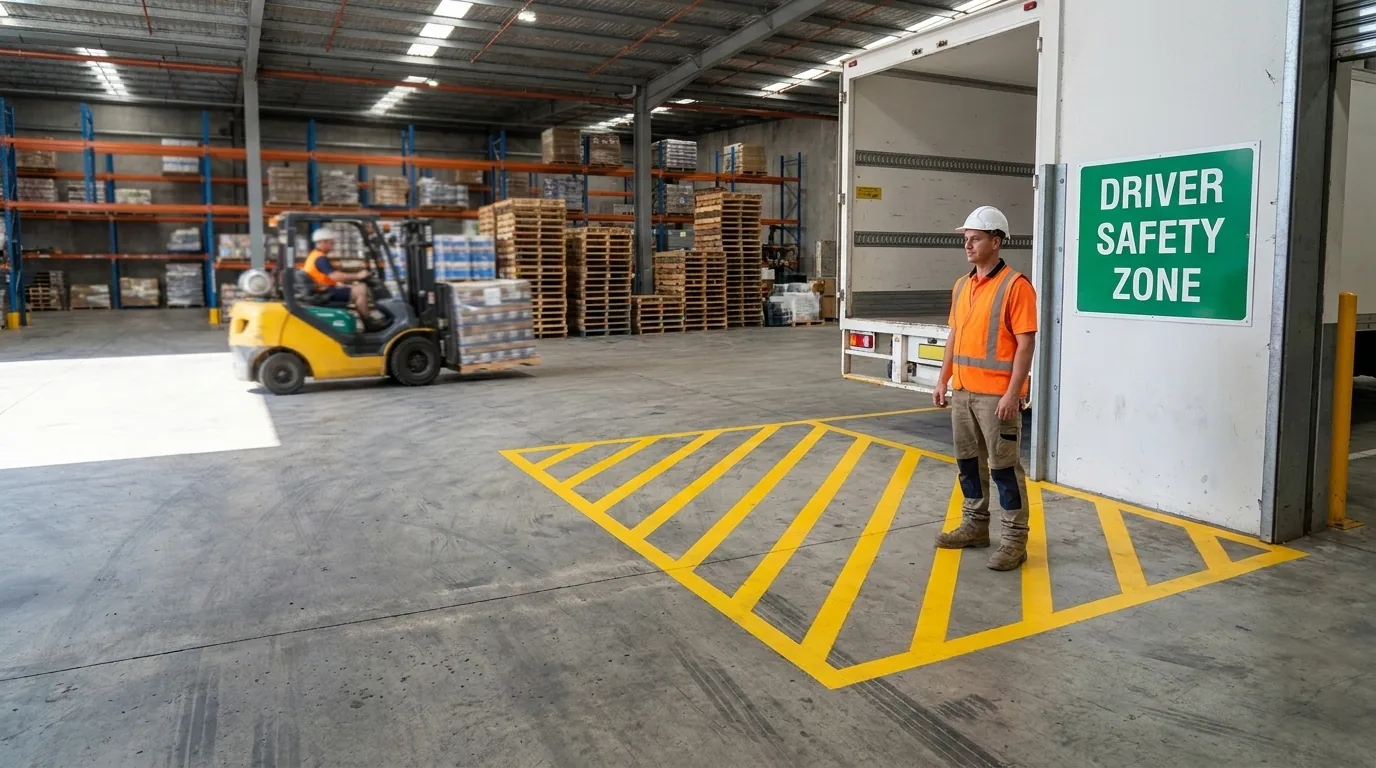
We have been making safety and compliance signage for Adelaide businesses for over 30 years, and warehouse and yard traffic signs are some of the most misunderstood jobs we quote. Everything is designed and finished at our Kent Town facility. If you are pulling together a full set of yard, dock and warning signs, our safety signage Adelaide range covers the lot, and this guide explains what actually drives the requirement.
What is a driver safety zone?
A driver safety zone is a marked area at a workplace where a delivery driver can safely stand, clear of moving forklifts, trucks and mobile plant, while their vehicle is loaded or unloaded. It is a specific control that comes out of separating people from vehicles. SafeWork SA's own forklift guidance recommends businesses "designate a safety zone for delivery drivers" as one of the practical controls in a traffic management plan, alongside barriers, exclusion zones and spotters (see SafeWork SA, Forklifts).
So a "driver safety zone sign" is the sign that marks and enforces that space. It tells a visiting driver where to wait, and it warns everyone else that the area is controlled. It is not a legally named sign type in its own right. It is a duty-of-care control that a workplace chooses to put in.
What does SA law actually require?
Here is where we stay honest, because a lot of signage sites overstate this. SA has no regulation that prescribes a specific "driver safety zone" sign, its wording or its size. What the law does require is a duty of care. Under the Work Health and Safety Act 2012 (SA), a business that manages or controls a workplace must ensure, so far as is reasonably practicable, that people are not exposed to risk. Vehicles and pedestrians sharing a yard is one of those risks.
That duty is met through a traffic management plan, not a shopping list of mandated signs. Safe Work Australia's national guidance spells out how signage fits in:
- Signs support a plan, they do not replace it -- the Safe Work Australia general guide for workplace traffic management lists signs as one control among physical barriers, exclusion zones, line marking and spotters.
- Signs indicate the zones you have created -- the same guide says signs should be provided to indicate exclusion and safety zones, parking areas, speed limits, vehicle crossings and hazards such as blind corners and where forklifts are in use.
- Separation distances are recommended, not signed by law -- the guidance recommends a minimum three metre separation between pedestrians and operating mobile plant, increasing to around ten metres for larger vehicles. Your signage and marking make that gap visible.
- Signs must be maintained -- faded or hidden signs are treated as no control at all, so they have to stay legible and unobstructed.
The practical upshot: the requirement is set by your risk assessment and traffic plan, and very often by a safety consultant who walks the site. If you want the full picture of what a compliant set looks like, our warehouse safety signs checklist runs through the common ones.
What should the signage say?
Because the wording is not fixed by law, the job is to make the message unmistakable and to build the sign to the recognised Australian design standard. Safety signs in the workplace are designed to AS 1319-1994, Safety signs for the occupational environment, which sets the colours, symbols, legend and size that make a sign read correctly at a distance. That standard is the reason a mandatory instruction looks different to a warning at a glance. We cover how it works in what is the Australian standard for safety signage.
For a driver safety zone and the traffic controls around it, the signs we typically build fall into a few groups:
- The zone marker itself -- a clear message such as "Driver Safety Zone -- Wait Here" so a visiting driver knows exactly where to stand while loading happens. Often paired with a painted or bollarded area on the ground.
- Mandatory signs -- blue-and-white instructions that must be obeyed, such as "Drivers Must Report to Office" or "High Visibility Clothing Must Be Worn Beyond This Point".
- Warning and hazard signs -- yellow-and-black alerts such as "Caution -- Forklifts Operating" or "Reversing Vehicles" at blind corners and dock edges.
- Prohibition and speed signs -- red-ring signs like "No Pedestrian Access" for forklift-only lanes, plus site speed limits.
If you want to understand the colour and symbol logic behind each of these before you order, our guide to safety signs and their meanings in Australia breaks it down.
How a site fit-out works
Here is what one of these jobs looks like in practice. A national logistics operator running a large warehouse in the Port Adelaide area came to Gigantic Signs for a full site-safety-signage fit-out. Rather than pick signs off a catalogue, they walked the site with a safety consultant first, mapping the traffic flow, the loading areas and the pedestrian routes against Australian-standard compliance.
Out of that walk-through came a coordinated set, which we manufactured and finished at Kent Town:
- A custom driver safety zone sign -- purpose-built to mark exactly where visiting drivers wait, clear of the forklift and truck paths the consultant had flagged.
- Fire door and emergency signage -- so exits and fire equipment stayed identifiable across the facility.
- No-smoking and no-e-cigarette signage -- prohibition signs placed where they were needed around the building.
- Illuminated building letters -- the branded identification signage, done in the same visit so the whole site was handled once.
The lesson worth taking away: the driver safety zone sign was not ordered because a rule named it. It was ordered because the consultant identified the risk on that site, and the sign was the control. That is how nearly every compliant fit-out works.
Frequently asked questions
Is a driver safety zone sign a legal requirement in SA?
Not by name. SA law requires you to control the risk of vehicles and pedestrians mixing, and a driver safety zone is one recognised way to do it. SafeWork SA recommends designating a safety zone for delivery drivers, so the sign supports a duty you already have.
What standard should the sign be built to?
AS 1319-1994 covers the design of workplace safety signs -- the colours, symbols and sizing that make them readable and correct. We build to that standard so a mandatory, warning or prohibition sign reads the way people expect at a glance.
Do I need a safety consultant to specify the signs?
For a simple yard, not always. For a busy warehouse or dock, it is common and sensible. A consultant maps your traffic and risks, and we manufacture the coordinated set that plan calls for. We can also come out and walk the site with you.
Ready to sort your site signage?
Whether you have a consultant's list or just know the yard is a risk, we can build the set that matches your traffic plan. Price a job on our quote tool, browse the range in the Gigantic Signs Online Store, or get in touch to arrange a site walk-through with our Kent Town team. Thirty years on, we still build every compliance sign to last, and to be read -- GIGANTIC.