
3 September 2026
How Is Hoarding Installation Priced?
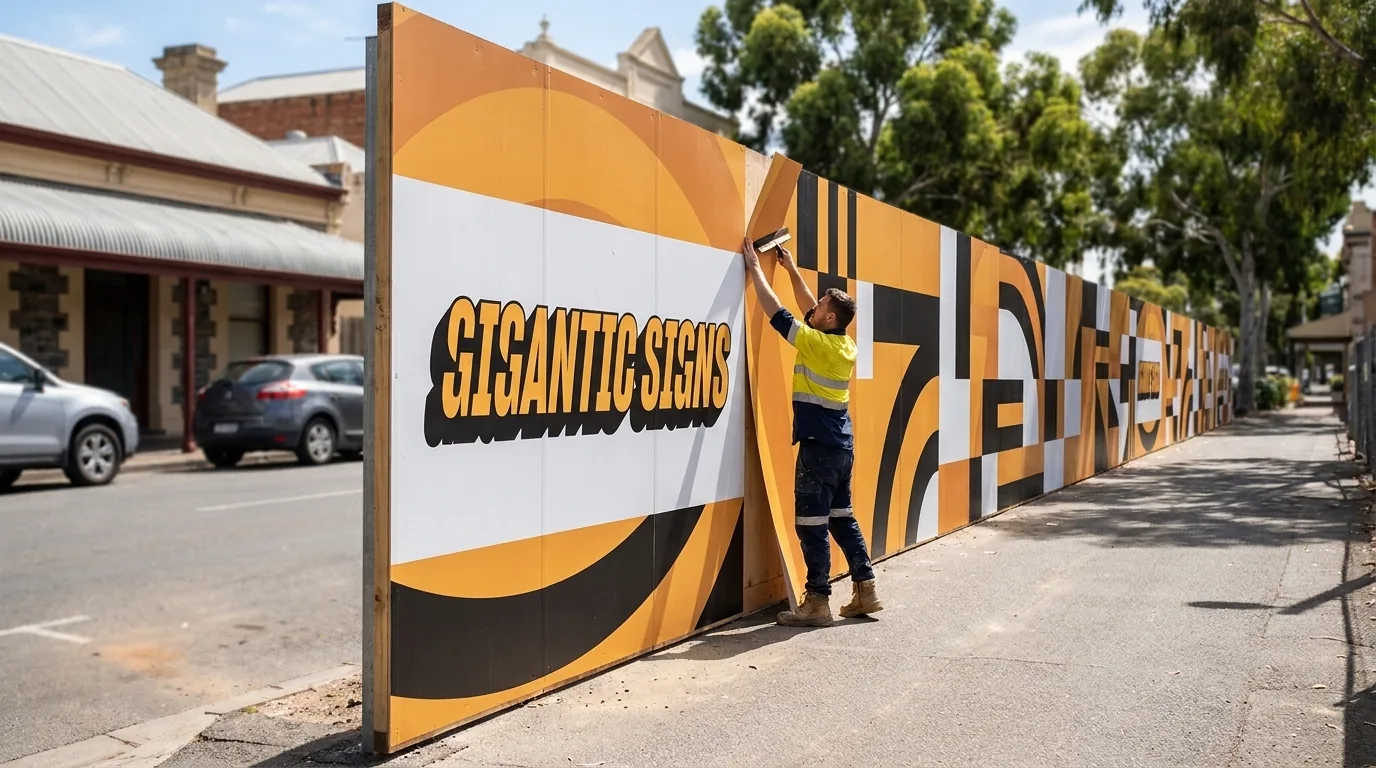
How is hoarding installation priced? The short answer: by the width of the run, not the height. Gigantic Signs in Kent Town divides your hoarding into vertical "drops" about 1.3m wide, prices the crew time to hang them, and factors in when the work has to happen -- because most Adelaide hoarding goes up after hours.
We've been installing signage across Adelaide for over 30 years, and hoarding wraps are one of the few jobs almost everyone prices wrong in their head. They see a tall, imposing panel and assume height drives the cost. It doesn't. Below is exactly how we work it out at our Kent Town workshop -- the same formula our instant hoarding wrap calculator runs -- so you can sanity-check any quote you're handed.
Why width matters more than height
A sheet of printed hoarding vinyl comes off the roll at a fixed practical width. Whether your hoarding stands 2m tall or 3m tall, one installer still hangs one vertical strip in roughly the same motion: line it up at the bottom, walk it up the wall, squeegee out the air. Height changes very little about how long that takes. Width changes everything -- because width is how many strips you have to hang.
So when a fit-out manager asks us to price a hoarding, the first number we care about is the total width of the run in metres. That single measurement tells us how big the job is and how long the crew will be on site.
What is a "drop" and how many will your hoarding need?
A "drop" is one vertical strip of printed vinyl, floor to top of the hoarding. We size drops at about 1.3m wide -- wide enough to cover ground fast, narrow enough that one person can control the strip without it folding back on itself and creasing.
To count the drops in a job, take the total width and divide by 1.3m:
- The maths -- a 9m hoarding run divided into 1.3m drops works out to about 7 drops.
- The crew rate -- a two-person crew hangs roughly 2.5 drops per hour when the surface and access are clean.
- The time -- so that 7-drop, 9m run is roughly a 3-hour crew visit, before we add setup, pack-down and any surface prep.
That's the whole engine. Count the drops, divide by the crew rate, and you have the labour time -- the biggest single lever on the price. It's why a wide, low hoarding can cost more to install than a narrow, tall one, even though the tall one looks like the bigger job.
Why two installers -- and why after hours?
Two things about hoarding work catch people by surprise on the quote: it's usually a two-person job, and it usually happens at night or early morning. Both come down to the same thing -- safety and access -- not padding the bill.
- Two people above about 1.5m -- once an installer is up a ladder, a second person on the ground is a hard safety rule. If someone comes off a ladder, another person has to be there to call for help. There's a practical reason too: one installer lines the drop up from the bottom and keeps it straight while the other works it up the wall. One person simply can't do both on a tall panel.
- The belly-band exception -- a short hoarding, say a 1.2m "belly band" running along a barrier at waist height, needs no ladder. That's a genuine one-person job, and it prices very differently because you're paying for one installer, not two.
- After hours -- hoarding almost always wraps an active shopping centre or a live construction frontage. You can't have installers on ladders through a corridor full of shoppers, so the work goes in after the centre closes or before it opens. After-hours labour costs more per hour, and that's baked into any honest hoarding quote.
So when a hoarding quote comes in higher than you expected for the print area, this is almost always why: two installers, on ladders, working after hours. It's not a markup -- it's what the job safely requires.
A quick Adelaide example
A centre manager came to Gigantic Signs to wrap a vacant tenancy on a busy Adelaide mall -- a 9m frontage that had been sitting behind bare board and hurting the look of the whole strip. We measured the run, divided it into 7 drops, and scheduled a two-person crew for an after-hours slot once the centre had closed. About three hours of hanging time later, a tired empty shopfront read as a branded "coming soon" wall. The manager knew the price before we booked it, because the drops count told us the crew time up front -- no guesswork, no surprise on the invoice.
How to price your hoarding in 60 seconds
You can rough out the shape of any hoarding job yourself in under a minute:
- Measure the width of the whole run in metres -- ignore the height for now.
- Divide by 1.3 to get your drop count (that 9m run = about 7 drops).
- Divide the drops by 2.5 to get the crew hours (7 drops = roughly a 3-hour visit).
- Flag the height and the site -- over about 1.5m means a two-person crew, and a live centre means after-hours rates.
That gets you the mechanics. For the actual dollars, skip the mental arithmetic and let our hoarding wrap calculator price it instantly from your width -- it runs this exact formula and adds the print, the crew and the after-hours factor for you. If you want the wider picture on what drives install pricing across every sign type, our guide to sign installation cost in Adelaide covers it, and if speed is your real concern -- filling a vacancy fast -- read how we turn hoarding around for shopping centre vacancies.
Frequently asked questions
Is hoarding priced by height or width?
By width. Installers hang vertical drops about 1.3m wide, and height barely changes how long one drop takes to hang. The total width sets the number of drops, and the drops set the crew time -- which is the biggest cost.
Why does hoarding installation need two people?
Above about 1.5m an installer is up a ladder, and safety requires a second person on the ground in case of a fall. One person also lines the drop up from the bottom while the other works it up the wall. A short belly-band under ladder height is a one-person job.
Why is hoarding installed after hours?
Because it usually wraps a live shopping centre or an active site. You can't run ladders through a corridor of shoppers, so the crew works once the centre closes or before it opens. After-hours labour costs more per hour, and that's built into the quote.
Get your hoarding priced the honest way
No mystery, no padded quote -- just width, drops, crew time and when the work happens. Measure your run and price it instantly with our hoarding wrap calculator, or get in touch and our Kent Town team will walk the site with you. The fairest quote is the one you can check yourself -- and ours are built GIGANTIC.