
15 September 2026
Fire Door Signage Requirements Australia
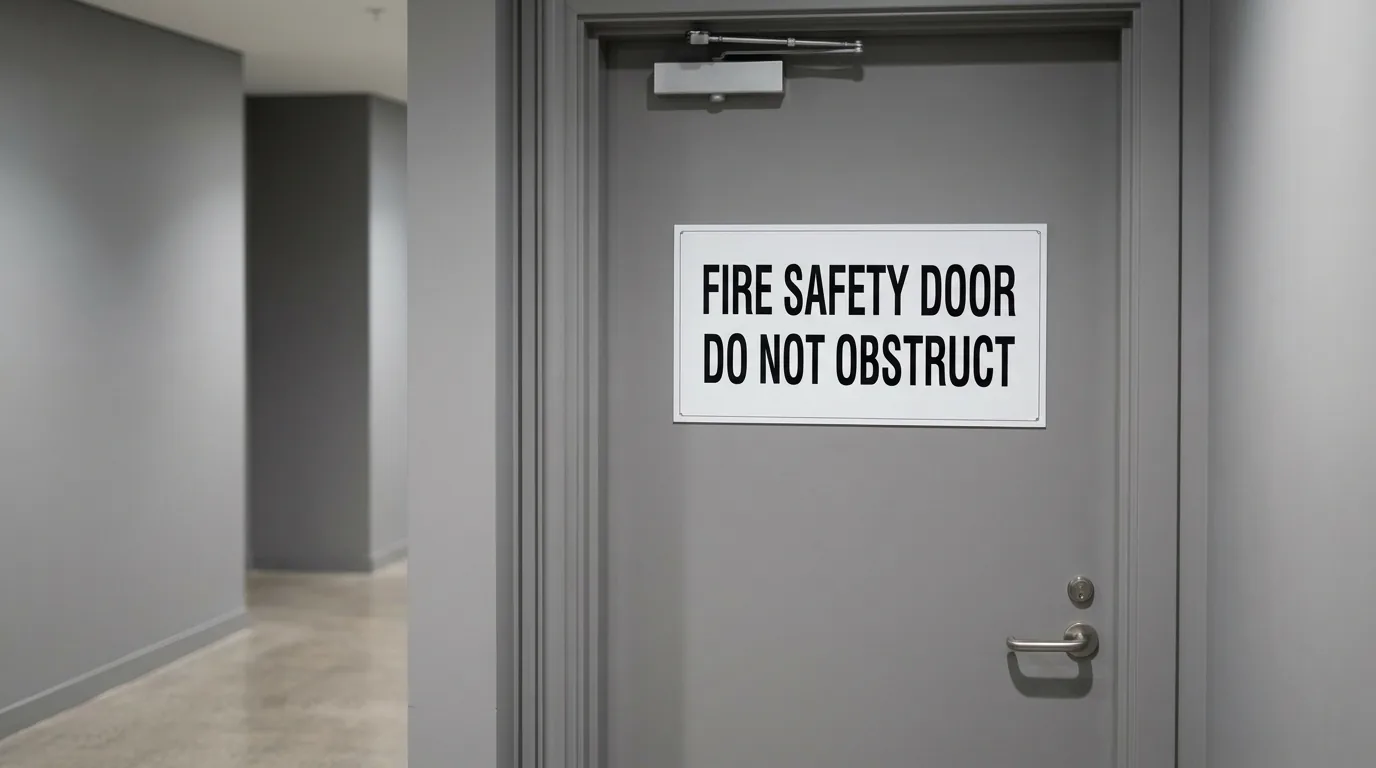
Need to get fire-door signage right for an Adelaide building? The short answer: every required fire door must be built and installed to Australian Standard AS 1905.1, and carry clear identifying signage that stays visible and is never obstructed. Gigantic Signs supplies compliant fire-door and statutory signs from our Kent Town workshop. Here is what the rules actually require.
We have been making signs for Adelaide businesses for over 30 years, and statutory signage is one of the areas people most often get wrong. Fire-door signs look simple, but they sit inside a chain of building and work-health-and-safety rules, and a non-compliant sign can fail an inspection. Everything we supply is produced at our Kent Town facility, and if you want the plain-English overview first, start with our guide to the Australian standard for safety signage.
What signs must a fire door have?
A fire door is a fire-resisting doorset built to slow the spread of fire and smoke between parts of a building. The governing document is AS 1905.1:2015 Fire-resistant doorsets, which sets out how these doorsets are constructed, installed and identified. The National Construction Code calls up that same standard, listing AS 1905.1 as the requirement fire doors must meet in its Specification 12 for fire doors and smoke doors.
In practical terms, a compliant fire door needs two things working together:
- An identifying legend -- the fire-safety wording that tells everyone the door is a fire door and must be kept clear (and, on some doors, kept closed).
- A door that stays fit for purpose -- the sign is only half the job. The doorset itself must remain compliant with AS 1905.1, which is why fire doors are inspected and tagged rather than treated as ordinary doors.
One point worth clearing up early: the illuminated green EXIT or running-man sign is not the same thing as a fire-door legend. Exit signs are a separate requirement under the NCC's rules for visibility in an emergency and exit signs. A door can need both.
What must the sign say?
The wording most people recognise is the fire-safety legend carried by compliant doorsets: FIRE SAFETY DOOR and DO NOT OBSTRUCT, with DO NOT KEEP OPEN added on self-closing doors that must not be propped. That identifying wording sits under AS 1905.1 and the relevant state fire-safety provisions. Because the exact letter height for that legend is set inside the purchased standard, confirm the required height for your specific door type rather than guessing at it.
Where the NCC sets its own numbers, it is precise. For a sliding fire door in a fire wall, clause C4D7 in the NCC's protection-of-openings provisions requires a sign on each side of the doorway, directly over the opening, in capital letters not less than 50mm high in a colour contrasting with the background, reading WARNING -- SLIDING FIRE DOOR. That gives you a good rule of thumb for every fire-door sign: capitals, high contrast, and large enough to read at a glance.
Where and how must the sign be mounted?
A fire door is used from both sides, so the legend needs to be readable from both approaches. The NCC's sliding-fire-door rule shows the principle in its clearest form: a sign on each side of the doorway, located directly over the opening, per the same protection-of-openings clause C4D7. For hinged fire doors the same logic applies in practice: fix the legend to both faces, at a height people see naturally, in a durable material that will not peel or fade.
Getting the mounting right matters as much as the wording:
- Both faces -- a fire door read from only one side leaves half the traffic uninformed.
- High contrast, capital letters -- the NCC's 50mm sliding-door benchmark is a useful floor for legibility on any fire door.
- Durable and permanent -- engraved or laminated signs outlast a printed label on a door that gets used hundreds of times a day.
- Never obscured -- notices, stock or coat hooks in front of the legend defeat its purpose and can breach your safety duties.
Who is responsible for fire-door signage?
Fire-door signage is part of a building's essential safety measures, and keeping it correct is a work-health-and-safety duty as much as a building one. In South Australia, SafeWork SA's emergency-response guidance requires clear, unobstructed routes out of a workplace and signs that show the way, and makes an emergency plan a legal requirement for every workplace. The person conducting the business (the operator or building owner) carries that duty, not the tenant who happens to lean a trolley against the door.
Keeping the door itself clear is spelled out further in the model Managing the work environment and facilities Code of Practice, which requires aisles and walkways be kept free of obstructions at all times. A compliant sign on an obstructed fire door still fails the intent of the rules, which is why the two duties travel together. If you are fitting out a workplace, our overview of safety signs and their meanings covers the wider mandatory set.
A recent Adelaide fit-out
A national logistics operator setting up a distribution warehouse in Adelaide asked Gigantic Signs to supply the full site-safety sign set, worked through on site with their own safety consultant against the Australian standards. Fire-door signs sat alongside a custom driver safety-zone sign, no-smoking and e-cigarette signage, and the building's illuminated letters. One coordinated order, produced in our Kent Town workshop, meant every sign matched and nothing was left to a last-minute scramble before the site opened. That is the value of ordering statutory signage as a set rather than piece by piece.
Frequently asked questions
What Australian standard covers fire doors?
Fire-resistant doorsets are governed by AS 1905.1, which the National Construction Code calls up as the standard fire doors must meet. It covers how the doorset is built, installed and identified.
What does a fire-door sign have to say?
The identifying legend is FIRE SAFETY DOOR and DO NOT OBSTRUCT, with DO NOT KEEP OPEN added on self-closing doors that must not be propped. Confirm the exact wording and letter height for your door type against AS 1905.1.
Can I block a fire door if it is only temporary?
No. SafeWork SA requires exit routes to stay clear and unobstructed at all times, so even a temporary blockage in front of a fire door is a problem.
Is a green EXIT sign the same as a fire-door sign?
No. The illuminated EXIT or running-man sign is a separate NCC requirement for visibility in an emergency. A fire door often needs both its fire-safety legend and a nearby exit sign.
Need compliant fire-door signs for an Adelaide site?
We make compliant fire-door and statutory signs to suit your building, in durable materials built for daily use. Price a job instantly with our statutory signs quote tool, browse the full compliant-sign range in the Gigantic Signs Online Store, or see our wider safety signage in Adelaide and get in touch if you would like a hand specifying a full site set. Thirty years on, we still make sure every statutory sign leaves Kent Town built GIGANTIC.