
7 September 2026
How Fast Can You Wrap a Vacant Shopfront? Hoarding for Shopping Centres
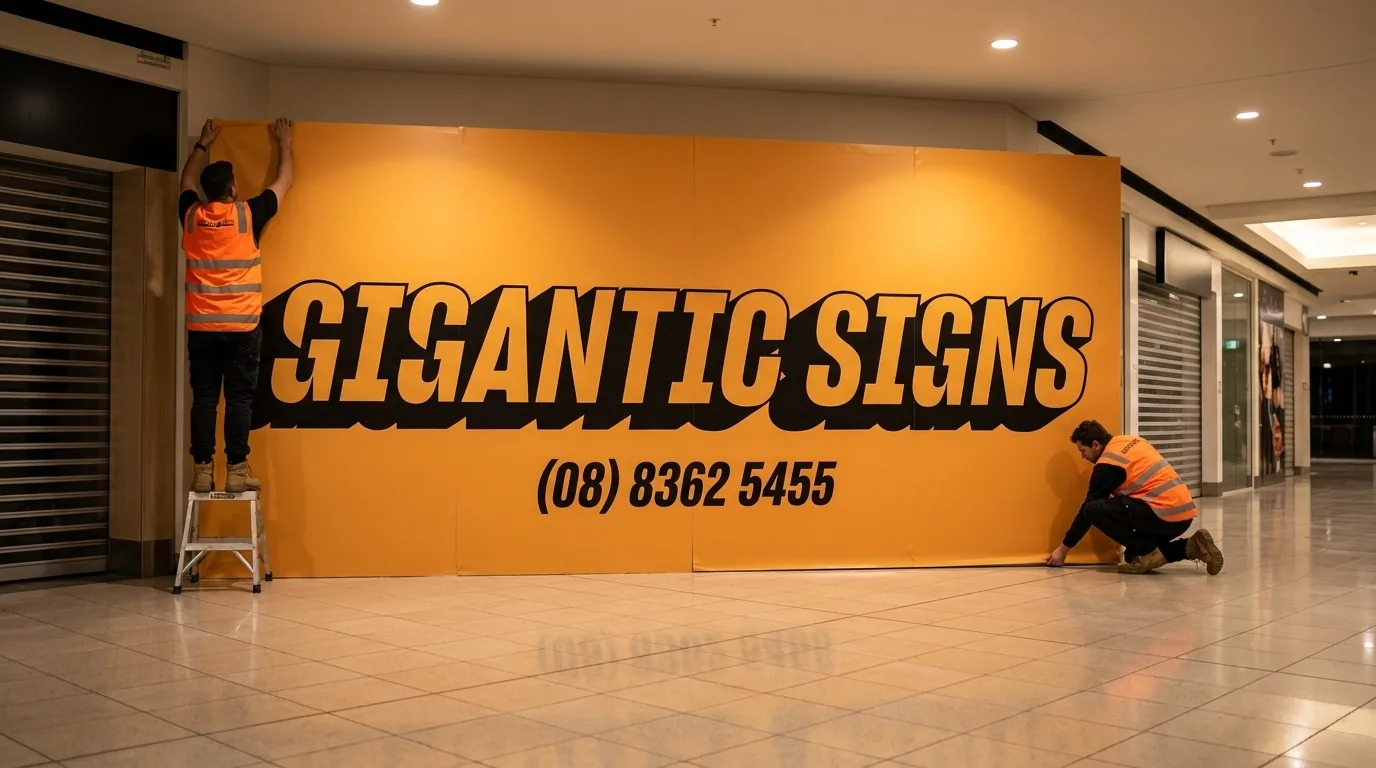
How fast can you wrap a vacant shopfront? Honestly, it depends on the print size and after-hours access, not on us dragging our feet. Gigantic Signs prints hoarding graphics at our Kent Town workshop and installs across Adelaide, and our instant online pricing removes the slowest part of the job -- waiting on a quote to land in your inbox.
We've been making and installing signs for Adelaide businesses for over 30 years, and hoarding wraps for shopping centres are some of the most time-sensitive work we do. Everything is printed and finished in-house at Kent Town, so we control the turnaround rather than waiting on a third party. If you want the wider range, see our outdoor signage options -- but for covering a vacant tenancy quickly and cleanly, a printed hoarding wrap is the tool for the job.
Why do vacant shopfronts need wrapping fast?
An empty tenancy is a dead spot in a busy centre. A dark, papered-over window tells every passing shopper that the place is struggling, and it drags down the shops either side of it. A printed hoarding wrap turns that gap into something that looks intentional -- branding, a "coming soon", or a clean graphic that keeps the mall feeling full and on-brand alongside your wayfinding signage. Here's why speed matters so much:
- First impressions compound daily -- every day a bare shopfront sits exposed is a day of foot traffic forming the wrong impression of the centre.
- Fit-outs run behind glass -- a wrap hides the mess of a tenancy changeover so the new operator can build out in private without an ugly gap on show.
- Reputation rides on your last turnaround -- centre and marketing managers are reactive by nature, and once you've covered a vacancy quickly, that becomes the benchmark they measure every job against.
That last point is the real driver. The managers we work with judge a supplier on how fast the last job went in. Get a wrap up quickly once and you're the first call next time. The two things that actually set the timeline are how big the graphic is to print and whether the install has to happen after hours -- so those are the levers to plan around, not chase.
How hoarding installation actually works
Most people picture a hoarding install as one big sheet going up. It isn't. A wrap is fitted in vertical strips, and the number of strips is what governs how long a crew is on site. Here is the honest mechanics of it:
- It's measured in drops, not square metres -- the printed vinyl goes up in vertical strips ("drops") roughly 1.3m wide. A 9m-wide shopfront is about seven drops. Width drives the job far more than height does.
- A crew fits a set number of drops per hour -- an experienced two-person crew works through them at a steady, predictable rate, which is exactly what lets us price the install up front instead of guessing.
- Anything tall is a two-person, after-hours job -- above roughly 1.5m we always send two installers. One lines up the bottom of each drop while the other works up top, and if someone's up a ladder there has to be a second person there for safety. Full-height mall hoarding almost always goes in after the centre closes.
- A low "belly band" is quicker -- a short 1.2m band of graphics across a lower barrier is a one-person job and goes in fast, which is handy for a quick refresh rather than a full cover-up.
None of that is secret, and it's the reason a bigger or after-hours wrap takes longer than a small one -- it's simply more drops and a tighter access window. For a full breakdown of what those crews and access rules do to the price, see our companion guide on how hoarding installation is priced, and the broader factors that move sign installation costs.
How to get a price without waiting for a quote
The old way of pricing hoarding was slow. A manager would send through a width, someone would run it against a rough estimate, and a formal quote would come back a day or two later. That gap is the delay that kills a fast turnaround -- and it's exactly what our instant calculator removes. Punch in your hoarding wrap dimensions and you get a price on the spot, no email chain, no waiting on someone to be at their desk. Price your wrap here:
Once the price is agreed, production can start straight away -- the quoting delay was the bottleneck, and taking it out is the single biggest thing that speeds up a vacant-shopfront cover-up.
What centre managers should have ready
If you want a wrap up quickly, the timeline lives and dies on what you can hand over on day one. Have these three things ready and there's nothing left to chase:
- Print-ready artwork -- the finished graphic, logos and any "coming soon" or leasing details in a high-resolution file. If the tenancy is being pre-leased, the incoming brand's artwork is what you want on the glass.
- Accurate measurements -- the full width and height of the shopfront opening. Width is what sets the number of drops and the install time, so getting it right up front is what makes the price and the timeline firm.
- Access details -- your after-hours access arrangements, loading dock and any centre induction requirements. Tall hoarding goes in after close, so confirming the access window early is often the difference between this week and next.
A quick Adelaide example
One shopping-centre manager we work with used to keep a simple spreadsheet that turned a shopfront width into a rough price -- handy for a ballpark, but their head office wanted a proper formal quote before anything was ordered, and that step is where the delay crept back in. Once we put instant pricing in front of them, that whole to-and-fro disappeared: they measure the vacancy, price the wrap online, and we're printing the same day. Because the first job went up cleanly and fast, we're now the first call whenever a tenancy goes dark. That's the loyalty a quick turnaround buys -- and the reason the process, not a promised deadline, is what we lean on.
Frequently asked questions
How fast can a shopfront be wrapped?
It depends on the print size and access. A small belly band is quick; a full-height mall hoarding is more drops and usually an after-hours install. The fastest path is having artwork, measurements and access sorted so production can start the moment the price is agreed.
How much does it cost to cover a vacant shopfront with printed hoarding?
It's priced by the width of the shopfront, not the height. The run is split into vertical drops about 1.3m wide, and the drop count sets the crew time, which is the biggest lever on the price. Print size and whether the install happens after hours move it too. Price yours instantly on the hoarding wrap calculator, or see how hoarding installation is priced for the full breakdown.
Does the wrap damage the shopfront glass or wall?
No. Hoarding wraps are applied to be removable and are taken down cleanly when the tenancy is filled, which is the whole point of a temporary cover-up. It protects the empty shopfront while it's on and leaves nothing behind when it comes off.
Can you do more than one vacancy at a time?
Yes. Centres often refresh several tenancies in one after-hours visit. Give us the widths for each and you can price the lot up front, so the whole run is booked and scheduled in one go rather than one quote at a time.
Ready to cover that vacancy?
Get the empty shopfront looking intentional and keep your centre feeling full. Price your job on our hoarding wrap calculator, browse the full range in the Gigantic Signs Online Store, or get in touch to talk through a multi-tenancy or after-hours install. Thirty years on, we still reckon the fastest fix for a dead shopfront is a wrap done properly -- and ours are built GIGANTIC.