
12 August 2026
Are LED Signs Worth It? LED vs Neon for Adelaide Businesses
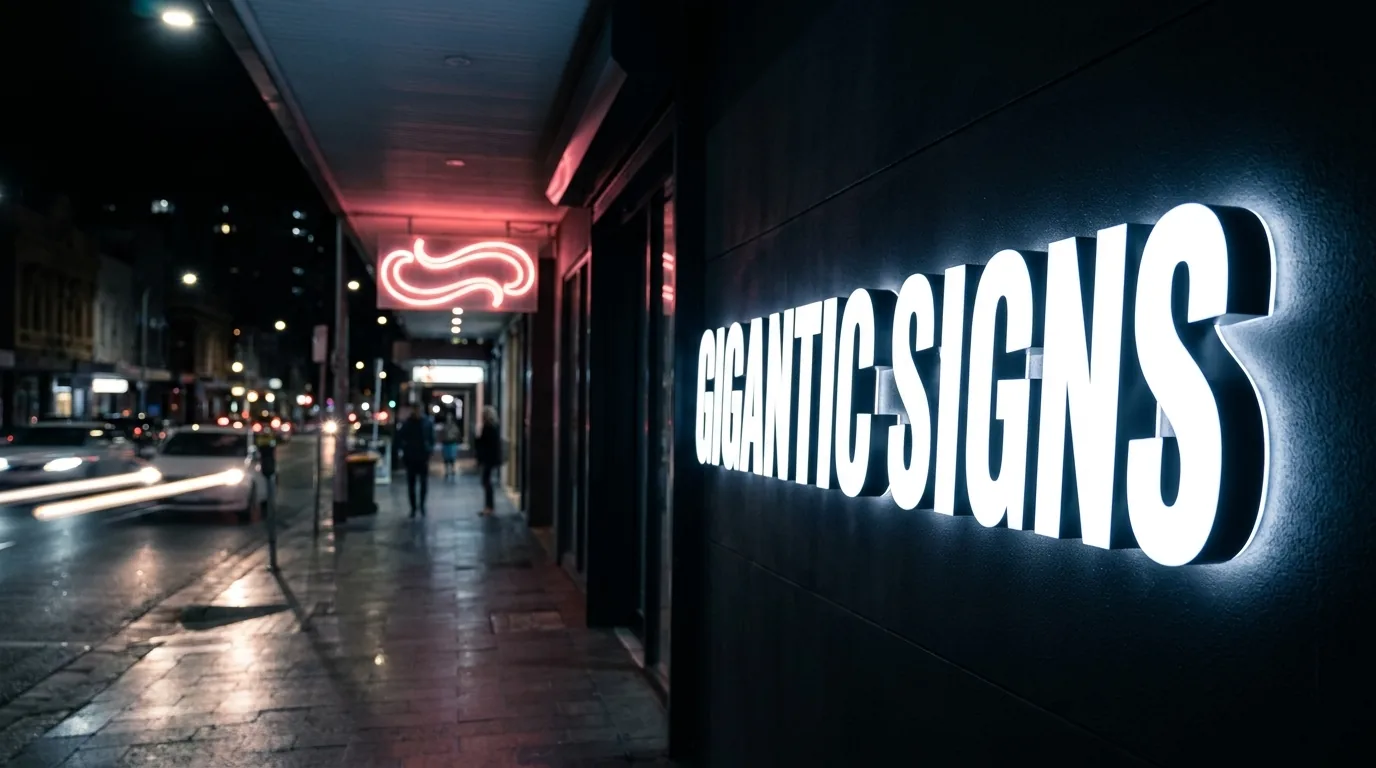
Are LED signs worth it? The short answer: for almost every Adelaide business, yes. LED illuminated signs from Gigantic Signs are brighter, tougher and far cheaper to run than old-style neon, and they last for years with very little fuss. We design and build them at our Kent Town workshop, so we know what survives a hot SA summer.
We've been making illuminated signs for Adelaide businesses for over 30 years, and the shift from glass neon to LED is one of the biggest changes we've seen. Everything is fabricated and finished in Kent Town, so we build the guts of the sign -- the LEDs, the wiring, the drivers -- to be reached and serviced, not sealed away. If you want to see the range first, browse our illuminated signage options. Below is the honest rundown on LED versus neon, running costs, lifespan and the few downsides worth knowing.
Are LED signs better than neon?
For most modern signs, yes. LED has largely replaced traditional glass neon because it is brighter, safer and far more durable. Neon uses fragile gas-filled glass tubes and high-voltage transformers that run hot and can break; LED runs on low voltage, stays cool, shrugs off knocks, and can even mimic the classic neon glow using flexible LED "neon" strip. You get the look without the fragility.
Here's how the two stack up on the things that actually matter for a shopfront:
- Durability -- LED is solid-state with no glass tubes or gas to leak. Neon is delicate and cracks or loses its glow if a tube is knocked or a seal fails.
- Brightness -- LED is punchy in full daylight, which matters on a busy Adelaide road. Neon has a lovely soft glow but can wash out against the sun.
- Safety -- neon needs high-voltage transformers; LED runs on low-voltage drivers that stay cool to the touch. Cooler and lower-voltage is safer on a wall or shopfront.
- The neon look -- if you specifically want that retro glow, LED "neon flex" gives you the same curves and colour with none of the breakage risk.
Do LED signs use a lot of electricity?
No. A well-made LED sign draws only a fraction of the power that an equivalent neon sign of the same size would pull. LED converts most of its energy straight into light instead of heat, so it sits in a much lower wattage class than neon or older lit signage. For an always-on shopfront sign that runs every night, that lower draw quietly adds up in your favour over a year.
Two things keep the running cost low on the signs we build:
- Efficient LEDs -- modern LED modules produce a lot of light per watt, so you light the same letters with less power drawn.
- Optional timers and sensors -- pair the sign with a timer or photocell so it only runs after dark, and you cut the hours it draws power at all.
Every sign is different, so we won't quote a power bill blind. But as a rule, swapping neon or an old lit sign for LED lowers the draw, not raises it.
How long do LED signs last?
A quality LED sign lasts a long time, but not every part ages the same way. The LEDs themselves can run for 10 to 15 years. The sign body and fabrication typically carry their own warranty, and the LED driver -- the small power supply that feeds the letters -- is the component most likely to need replacing first, well before the LEDs ever fade.
That split is worth understanding before you buy. A sign is really three things with three different lifespans: the fabricated body, the LEDs, and the driver behind them. The LEDs are the long-lived part. The driver is the short-lived part, and if it dies it takes a whole letter or section dark with it -- even though the LEDs are perfectly fine. That's why the driver has to be reachable for a quick swap, not buried inside a sealed box. We go deeper on the warranty split in our guide to how long illuminated signs last.
What are the downsides of LED signs?
There are only a few, and all of them are avoidable. The cheap "neon-look" LED letters sold online are mass-imported and thin on quality, so they can disappoint. The LED driver is the part that fails first, which is exactly why it must be reachable for servicing. And a poorly built LED face can still look dim or patchy if the wrong acrylic is used behind it.
- Cheap imports -- most bargain neon-look LED letters are imported and built to a price. Fabricated, locally made letters cost more but hold up far better outdoors.
- The driver is the weak link -- it will likely be the first thing to replace. Build the sign so a technician can reach and swap it from a ladder, and a failure is a quick fix, not a new sign.
- Build quality shows -- the right diffusing acrylic and proper back-lighting are what make an LED face read bright and even. Skimp there and the sign looks dead no matter how good the LEDs are.
Note that this is all about lit signs and letters. If you're weighing an illuminated sign against a full digital screen instead, that's a different comparison -- see our guide to LED vs LCD screens for venues.
A quick Adelaide example
A business not far from our Kent Town workshop had 3D illuminated letters made by another sign company only a few years earlier, and one letter had already gone completely dark. The LEDs were fine -- the small driver feeding that single letter had failed, and it had been sealed inside the sign where nobody could reach it. Fixing it properly meant opening the sign up. When we build a set of letters, each driver sits somewhere a technician can get to it, so a failed part is a fast, cheap swap rather than a reason to replace the whole sign. That design choice is the difference between a sign that lasts and one that quietly dies a letter at a time.
Frequently asked questions
Are LED signs cheaper to run than neon?
Yes. An LED sign draws a fraction of the power a neon sign of the same size would, because LED makes light rather than heat. Over a year of nightly use, that lower draw is a real saving.
Can LED look like real neon?
It can. Flexible LED "neon" strip gives you the same continuous glow and curved lettering as glass neon, in a huge range of colours, without the fragile tubes or high-voltage transformer.
Do LED signs get hot?
Barely. LED runs cool and on low voltage, which is one reason it's safer than neon on a shopfront. The only warm part is the driver, and on our signs that sits where air can move around it and a technician can reach it.
Ready to light up your shopfront?
If you want a lit sign that's bright, cheap to run and built to be serviced, LED is the call. Price your illuminated sign instantly with our quote tool, see what's possible on our illuminated signs page, or call our Kent Town team on (08) 8362 5455 to talk it through. Thirty years on, we still build every sign to last -- and we build them GIGANTIC.